In short, it seems the lights of the 2025 Cross-Border European Capital have by no means gone out. And it’s not just a matter of appearance. That driving force that emerged around the bid by two cities separated by an almost invisible border seems to be as strong as ever. Culture, seen as a source of sharing, inclusion and participation, still seems deeply alive in the numerous activities planned between Gorizia and Nova Gorica, between Italy and Slovenia.
Taking advantage of a few days’ holiday, EcocNews decided to see for itself the legacy of Go!2025 – a spot-on nickname, not only because it links both cities with just two letters, but also because it signifies a movement, an encouragement to carry on with the work already done.
The legacy of a European Capital of Culture can encompass many aspects of a city’s life, ranging from the, so to speak, intangible – such as people’s skills – to infrastructural elements. And it is becoming increasingly central in the context of the competition organised by the European Commission. It is now well known that the ‘Legacy’ also forms a fundamental part of the commission’s assessment when evaluating a Capital of Culture.
In Nova Gorica and Gorizia, we saw for ourselves that much has been preserved – and not just in terms of branding or clothing.
In addition to the events that continue to enliven the cultural life of this cross-border city by bringing together Slovenian and Italian artists, and Italian and Slovenian projects, we were particularly struck by two specific cultural facilities in Gorizia’s legacy: the DAG, the Digital Art Gallery in Gorizia, and Epic in Nova Gorica. Indeed, it is almost paradoxical to divide them between the two cities, as the two facilities are only about a 20-minute walk apart.
DAG
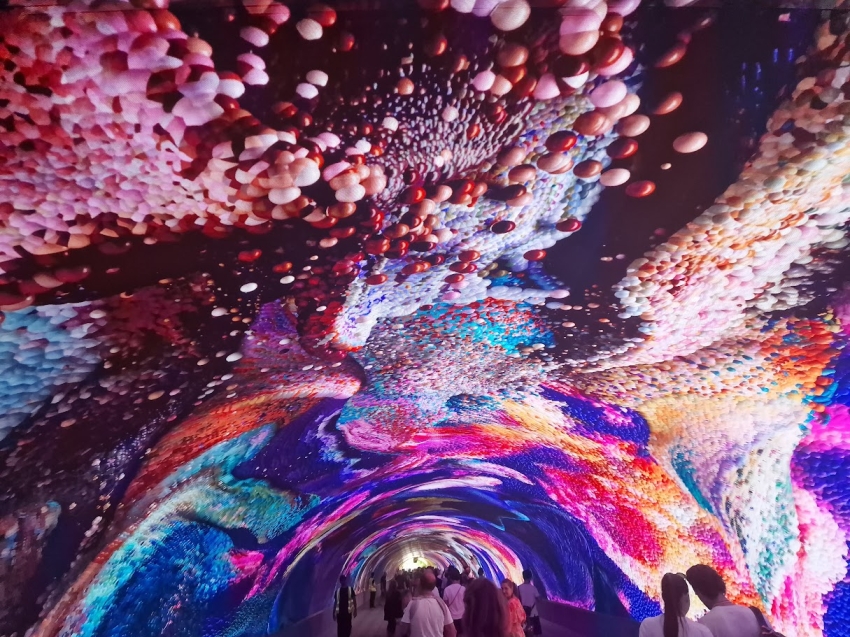
In the heart of Gorizia, at the foot of the castle, in the historic Galleria Bombi, the DAG – Digital Art Gallery – is one of Europe’s most ambitious venues dedicated to immersive digital art. The project, due to open between 2025 and 2026, represents one of the most innovative legacies of GO!2025 – European Capital of Culture, transforming an ancient urban passageway into a permanent and reconfigurable visual environment.
The DAG is a tunnel approximately 100 metres long, entirely clad in high-definition LED walls, covering a total digital surface area of almost 1,000 m². It is not a temporary exhibition, but a permanent platform: the hardware remains fixed, whilst the content can change over time, allowing for multi-year, multi-artistic programming. This tells us that it is an infrastructure project designed to stand the test of time. The idea is simple and revolutionary: to make the city a place where digital art becomes part of everyday life.
The space was inaugurated by Refik Anadol, one of the most influential artists in the field of new media art. At its conceptual heart lies the Large Nature Model, an artificial intelligence system trained on millions of images of ecosystems and natural materials. This model transforms the gallery into a living organism, where botanical textures, atmospheric rhythms and oceanic pulses unfold across the 100-metre LED wall. ‘The concept is to connect two worlds and two cultures. Nature is everywhere, and it is a common language: you will see millions of images take shape in the tunnel,” he explained. This is precisely it: connecting two worlds, two cultures, in perfect harmony with the cross-border capital.
The future of the DAG is already written into its architecture: as a reconfigurable platform, it will be able to host international artists, generative art forms, local narratives and educational projects. The Galleria Bombi thus becomes a European cultural corridor, where historical memory engages with the aesthetics of the future. Gorizia is gaining a space that is unique on the European scene, capable of evolving over time and guiding the city towards new forms of public creativity.
For Anadol, who has been working on data aesthetics and the artistic applications of artificial intelligence for over ten years, the work marks a turning point: ‘This is probably the first time this kind of project has been realised in a tunnel. This physical space becomes a work of art, and my work focuses precisely on public art.’
Epic
Among the most significant legacies of GO! 2025, EPIC – Enterprising People in Communities is the project that best illustrates the cultural and social transformation envisaged for Nova Gorica. Also born out of the impetus of Nova Gorica – European Capital of Culture 2026 as a permanent platform, EPIC is a centre dedicated to skills development, innovation and applied creativity, designed to guide citizens and professionals towards new forms of participation and cultural entrepreneurship.
At the heart of the project is a multifunctional space hosting workshops, training programmes, idea incubators and empowerment initiatives aimed primarily at young people. Here, culture is not merely artistic production, but a driver of growth: a place where one learns to plan, collaborate and devise solutions. In EPIC, the artist is the community itself, called upon to take centre stage in creative and social processes.
The exhibition dedicated to the 20th century, currently on display at the centre, helps to reinforce this vision. The exhibition traces the tensions, innovations and divisions of the last century, creating a dialogue between historical memory and contemporary challenges. It is not merely a museum exhibition: it is an educational tool that enables visitors to understand how the transformations of the 20th century continue to influence the present, offering insights into how to interpret the future with greater awareness.
EPIC’s destiny is enshrined in its mission: to become a permanent hub of expertise and creativity, capable of supporting the region’s growth well beyond 2025. A place where culture becomes infrastructure, where ideas are transformed into projects, and where the memory of the past — as embodied by the 20th century — fuels new forms of social innovation. Nova Gorica is thus building a living legacy, one that not only celebrates its year as European Capital of Culture but also prepares a new generation of citizens capable of driving change.
Whilst on the ground floor we find a lovely reception area and the exhibition space where every citizen can bring in artefacts from their own history to be displayed alongside others, creating a true narrative of a community, on the second floor there is a spacious exhibition area that the organisers are making available not only to the local community but also to the other European Capitals of Culture.
“It would be wonderful if,” says Klavdija Figelj, head of Media relations, “each European Capital of Culture took it in turns to use this space to showcase their projects and activities. And I’m not just talking about the cities that have been designated, but also those that are candidates. This space is intended to be not only a cross-border space between two cities, but also between different European countries far from us.”
Whilst walls are going up in other parts of Europe, here borders are being erased. And this is perhaps, above all else, the finest legacy of Gorizia and Nova Gorica.
Nova Gorica will soon be called upon to elect a new mayor. We shall see whether there will be further momentum in the direction already taken, or whether this community will be forced to start all over again.
The issue of a possible change in local government will need to be central to the new planning cycle for the European Capitals of Culture.
In the meantime, all we can say is: Go! On.


