The responses have been provided by the LPGC’31 communications department.
Why did the city decide to be the European capital of culture?
The city decided to bid for the European Capital of Culture because it saw the process as an opportunity to place culture and creativity at the heart of its long-term urban development. Rather than approaching the title as a one-year cultural celebration, Las Palmas de Gran Canaria conceived the candidacy as a catalyst for transformation: strengthening the local cultural ecosystem, creating new opportunities for artists and cultural organisations, fostering participation and cultural rights, and building stronger connections with Europe.
At the same time, the city felt that it had a distinctive perspective to contribute to the European conversation. As an island city located on Europe’s geographical periphery and at the crossroads between Europe, Africa and the Americas, Las Palmas de Gran Canaria has historically been shaped by mobility, exchange and cultural diversity. The candidacy therefore became an opportunity to rethink what it means to be “at the centre” of Europe and to bring perspectives, identities and knowledge from its geographical margins into the European cultural debate.
This ambition eventually developed into the concept of ‘Rebelión de la Geografía’ (Geography Rebellion): using culture to challenge conventional centre-periphery relationships, respond to contemporary urban and social challenges, and explore new models of cultural, democratic and sustainable development
What changes are expected for the reference community?
The main expected change is to strengthen the role of culture in the everyday life and long-term development of the city and its communities. The European Capital of Culture process is expected to create more opportunities for citizens to participate in cultural life, not only as audiences but also as active contributors to the cultural transformation of the city.
For the local cultural and creative sector, the process should strengthen capacities, encourage new forms of collaboration, improve professional opportunities and create more sustainable connections with European and international networks. Particular attention is also given to younger generations and to communities that have traditionally had fewer opportunities to participate in cultural life.
At a broader level, the candidacy aims to reinforce a sense of belonging while opening the city further to Europe. As an island and peripheral territory, greater mobility, exchange and cooperation are especially important. We expect the process to generate new relationships between local communities, artists, institutions and European partners, creating opportunities for knowledge exchange and mutual learning.
Ultimately, the ambition is that the impact goes beyond 2031: leaving a stronger and more connected cultural ecosystem, greater cultural participation, new skills and capacities, and a community that feels more empowered to contribute to the future of the city. In this sense, ‘Rebelión de la Geografía’ is also about transforming perceived geographical limitations into opportunities for connection, participation and cultural innovation.
What are the three keywords of your cultural program?
Insularity , Rebellion, Connection.
INSULARITY - Insularity is not isolation. It is a way of seeing the World. As an island city at the Atlantic crossroads of Europe, Africa and the Americas, Las Palmas de Gran Canaria starts from a geographical condition that has often been understood as peripheral. Geography Rebellion proposes to turn that condition into a source of perspective, creativity and agency. Insularity shapes how we inhabit space, how we build communities, how we relate to our environment and how we understand belonging. It also gives us a particular capacity to question the conventional European map: what if the edges were not the margins, but places from which to look at Europe differently? Our programme embraces the island as a living cultural territory: diverse, connected, mobile and constantly transformed by encounters between people, cultures and identities. Insularity means turning the island from a geographical limitation into a cultural point of view.
REBELLION - Rebellion means questioning where the centre is — and who gets to define it. Geography Rebellion is an invitation to challenge inherited ways of representing Europe, its territories and its cultural narratives. It is not rebellion for rebellion's sake, but a constructive act of rethinking: who is visible, who participates, whose knowledge matters and where cultural value is produced. From an island and an outermost region, we challenge the idea that culture must flow from the centre towards the periphery. Instead, we propose a more plural European cultural geography, in which neighbourhoods, communities, artists, cultural organisations, migrants, young people and citizens are active producers of culture. This rebellion is therefore also about cultural democracy and the right to culture. It seeks to redistribute attention, participation and agency, creating spaces where different voices can shape the city and contribute to Europe's cultural future. Rebellion means changing the map — not only geographically, but culturally, politically and imaginatively.
CONNECTION - Connection turns our geographical position into an opportunity for exchange. Las Palmas de Gran Canaria is located on an island, but it has never been disconnected from the world. Its history, population and cultural identity have been shaped by movement, migration, trade, exchange and encounters across the Atlantic. Our cultural programme builds on this condition to create new connections: between islands and mainland Europe, between the local and the international, between generations and communities, between culture and other areas of society, and between Europe, Africa and the Americas. Connection is also at the heart of our European ambition. We do not want to bring Europe to the island as something external. We want to contribute our own perspective to the European conversation and create networks in which islands and peripheral territories can become active protagonists. Through international collaboration, artistic exchange, mobility and shared projects, Las Palmas de Gran Canaria can transform its position at Europe's geographical edge into a platform for dialogue. Connection means turning distance into possibility and the island into a meeting point.
What are the main citizen involvement activities?
Citizen involvement is conceived as a continuous process of participation and co-creation, rather than simply attendance at cultural events.
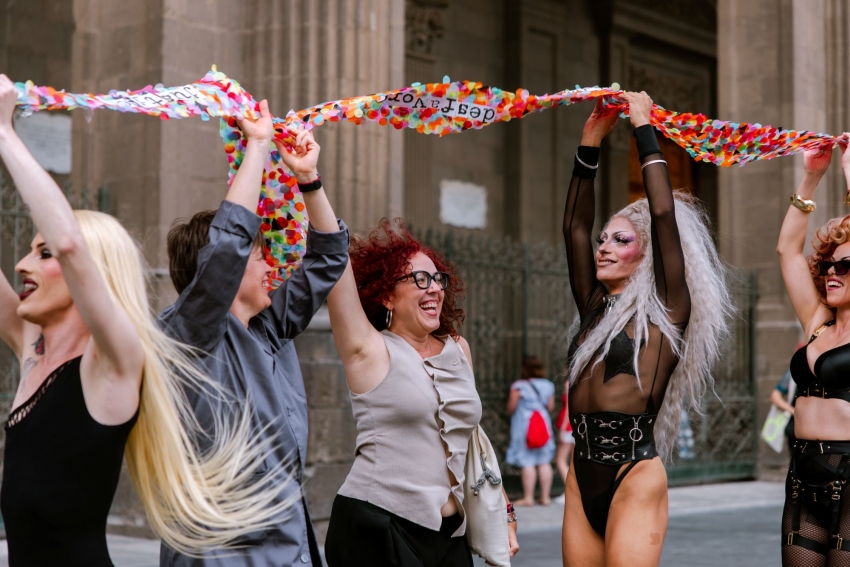
The main activities include open meetings and participatory sessions, workshops, community-based cultural activities, specific processes with children and young people, and initiatives that activate public and cultural spaces in new ways. Recent examples include the TAC! Urban Architecture Festival, which transformed a central public space into a meeting point for citizens, artists, architects and cultural organisations through workshops, performances, conversations and participatory activities; Jam en la Plaza, an open and informal format that brings live music, creativity and collective participation into public space; and REBEL WALLS. Urban Stories, the activation of Castillo de Mata as a space for urban culture and community participation, with activities such as rap workshops and dance sessions for young people. These activities encourage direct participation, particularly among younger audiences, and open up cultural spaces to forms of expression and communities that are not always represented in traditional cultural programming.
These initiatives complement other participation mechanisms, including meetings with cultural and social organisations, activities with children and young people, and open channels for citizens and organisations to contribute ideas and proposals to the candidacy.
The aim is to experiment with different forms of participation already during the candidacy phase: bringing culture closer to everyday life, creating new uses for public and cultural spaces, and involving citizens not only as audiences, but increasingly as contributors, creators and partners in the development of LPGC’31.
What do you want to remain after the capital year?
What we want to remain after the Capital year is, above all, a new way of making culture: more inclusive, plural, participatory and connected to the territory and its communities.
We want 2031 to leave a real and lasting footprint in Las Palmas de Gran Canaria and across the Canary Islands, strengthening a cultural ecosystem in which citizens, artists, institutions and communities work together in new ways. The legacy should not simply be a collection of events or new infrastructures, but a change in how culture is understood, created, shared and supported.
A key part of this legacy is also internationalisation. As an island territory, creating lasting opportunities for mobility, exchange and international cooperation is essential. We want artists and cultural professionals from the Canary Islands to build stronger and more sustainable connections with European and international networks, opening new opportunities for collaboration, learning and professional development.
At the same time, we want the European Capital of Culture to reveal the extraordinary creative potential of Canary Islands artists beyond the archipelago. We want 2031 to act as a platform from which local talent can connect with Europe and the world, while international artists and organisations discover the Canary Islands as a place for creation, experimentation and cultural exchange.
Ultimately, the most important legacy would be a cultural ecosystem that is more open, diverse, confident and internationally connected, and a new generation of cultural projects, professionals and citizens with the capacity and networks to continue that transformation well beyond 2031.