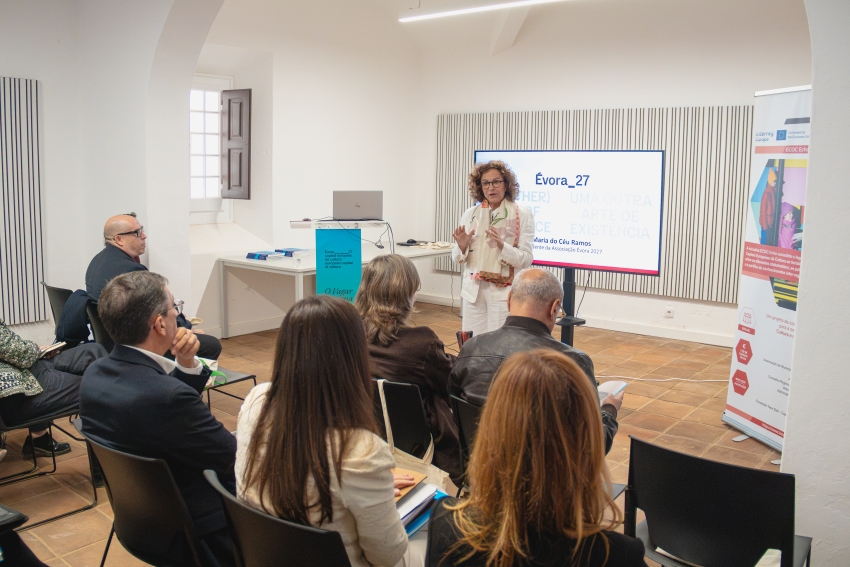
The programme opened with some welcome words by Maria do Céu Ramos, President of the Évora 2027 Association, followed by a presentation of the ECoC Echo project by António Costa da Silva, Financial Director of the Évora 2027 Association. The session also included a discussion of lessons learned and best practices from other European Capitals of Culture, featuring examples from Tartu 2024, Veszprém-Balaton 2023, Leeuwarden 2018, Novi Sad 2022 and Chemnitz 2025, presented by Carmen Caetano, Project Coordinator at Évora_27.
One of the meeting’s central themes was the development of Évora_27’s legacy, through the presentation and discussion of projects and initiatives structured around four key areas: heritage regeneration, sustainability and climate action, artistic and cultural repertoire, and a cultural management platform and governance model. In the area of heritage regeneration, projects associated with Évora City Council were discussed, including the Garcia de Resende Theatre, Salão Central Eborense, acoustic improvements to the Évora Arena, interventions at Rossio de São Brás, and the former EPAC granaries.
Other interventions were also presented, namely the renovation of the former National Road Transport Company building and the Picadeiro dos Dragões, alongside further projects developed by the Évora 2027 Association within the Évora_27 programme. The São Bento de Cástris Convent (PC, I.P.) and the Welcome Centre (Alentejo Regional Tourism Authority) were also addressed.
The session featured contributions from Teresa Batista (Head of the Office supporting the Presidency and Councillors of Évora City Council), and Maria João Costa and Helena Mourato, both members of the Évora_27 team. This area highlighted the importance of enhancing heritage sites and integrating them into a long-term cultural strategy. Sustainability and climate action were also in the spotlight, with presentations of initiatives such as Bosk – Évora’s Nomad Forest, by Helena Mourato, and Tertúlia do Montado, by José Potes (Institute MED, University of Évora).
These projects reflect the connection between culture, territory and the environment, encouraging discussion of sustainable practices and the value of local resources.
Évora_27’s artistic and cultural repertoire formed another key area of discussion, with presentations of projects such as the Coro do Vagar, by Eduardo Luciano (CIMAC Intermunicipal Secretary), Linha de Encontro, presented by Ana Isa (Head of the Multidisciplinary Team of CIMAC’s Unit for the Promotion and Development of Culture), and the Alentejo Regional Orchestra, associated with the University of Évora, presented by António Sáez Delgado, Vice-Rector for Culture at the University of Évora.
The creation and consolidation of artistic and musical projects represent an important dimension of building a cultural offering that can remain active over time and engage diverse audiences. The cultural management platform and governance model were examined through contributions from António Costa da Silva and Maria do Céu Ramos, including a presentation of VAGAR – International Cultural Movement.
This area focused on the mechanisms of coordination, collaboration and organisation required to sustain the cultural momentum generated by Évora_27. By bringing international experiences, local projects and different institutional and cultural perspectives into dialogue, the meeting sought to contribute to a shared vision for Évora_27’s legacy, based on heritage enhancement, sustainability, artistic creation and stronger networks of cooperation.