Throughout the visit, which took place at different locations across the city, the experts were able to see first-hand the involvement of public administrations, cultural institutions and Extremadura's creative sector, as well as the commitment of associations, social groups and citizens to a bid that aims to connect Extremadura with Europe's cultural future.
The day began with an institutional breakfast at Atrio, bringing together representatives of public administrations and some of the main cultural institutions involved in the project. Participants included the Mayor of Cáceres, Rafa Mateos; the Councillor for Culture, Jorge Suárez; the Regional Minister for Culture, Tourism and Sport of the Government of Extremadura, Laureano León; the President of the Provincial Council of Cáceres, Miguel Ángel Morales; and the Deputy for Equality of the Provincial Council of Badajoz, Lourdes Linares; representatives of foundations, museums and cultural organisations, alongside the General Coordinator of Cáceres 2031, Iris Jugo.
The meeting provided an opportunity to convey to the committee the institutional consensus supporting the bid and the commitments made to ensure its development, within the framework of a cultural strategy for Cáceres and Extremadura that extends beyond 2031.
The city becomes the stage for Transcultura
One of the central moments of the visit was the artistic journey through the historic centre of Cáceres, a UNESCO World Heritage Site, which transformed its streets and squares into stages for contemporary artistic creation.
Guided by a shepherd portrayed by actor Jorge Barrantes and by the character of Europa, played by Iván Luis, the experts visited different locations across the city in an experience inspired by transhumance, an essential element of Transcultura and a metaphor for the paths that connect territories, knowledge and cultures.
Live music, dance and performing arts accompanied the itinerary, with performances by artists and groups including Adrián Domínguez, Lara Martorán, María Milán, Irene Naranjo, Raigambre, Iris Miralles and Inés del Río, among other participants. The journey included performances such as Lucha Versal, El origen and various contemporary dance interventions, with the collaboration of the Sbelta Dance School, the Higher School of Dramatic Art of Extremadura and the University of Extremadura.
The experience, artistically directed by Cristina D. Silveira, from Karlik danza-teatro / La Nave del Duende, demonstrated how Cáceres' heritage can engage in dialogue with new forms of artistic expression and become a living space for cultural encounter.
The visit then continued at Cáceres City Hall, where a reception was held in the council chamber with representatives of the municipal government, political groups and technical staff from the administration. During the meeting, the governance model of the Cáceres 2031 Consortium was explained, based on institutional cooperation, artistic autonomy and a commitment to a long-term cultural strategy.
A bid supported by the cultural sector and citizens
The Helga de Alvear Museum of Contemporary Art was another of the day's venues. Its director, Sandra Guimarães, presented the institution's international dimension and its participation in the Cáceres 2031 programme during a meeting with representatives of Extremadura's cultural and creative ecosystem.
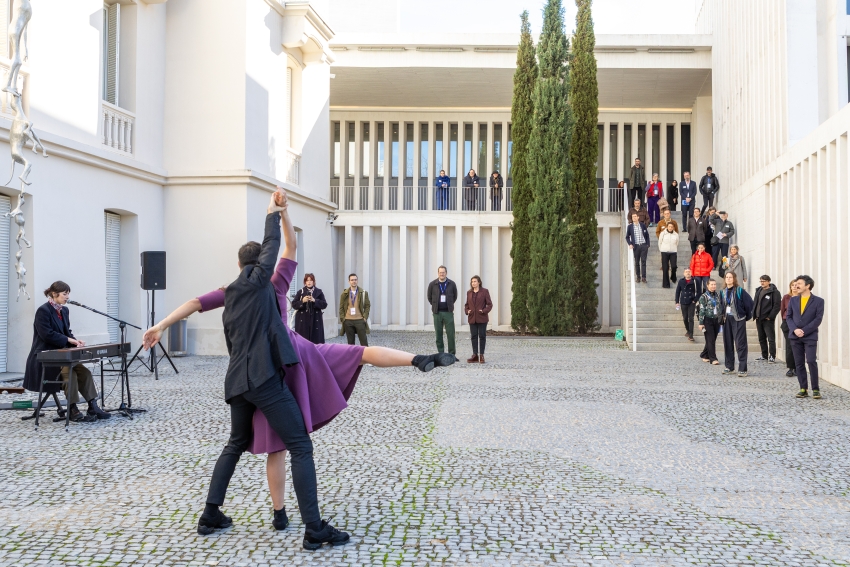
The visit included an artistic performance in the museum courtyard featuring Iván Luis, bassoonist Hugo Lagar Salguero, artist Chloé Bird and dancers Carla González and Francisco García, coordinated by Cristina Silveira.
The itinerary continued at Espacio Mercado, where the committee learned about the work of the Office for Cultural Activation (OAC), one of the main structures for participation and legacy promoted by Cáceres 2031. There, associations, artists, volunteers and users shared their experiences and demonstrated how the bid is generating opportunities for collaboration and cultural creation.
The recovery of the former food market as a meeting space, within the Habitat programme, served as an example of Cáceres 2031's commitment to transforming spaces in the city and bringing culture closer to citizens. Experiences linked to Rural Labs and inclusion and accessibility projects integrated into Diversitas were also presented.
Extremadura and Europe, a shared path
The European dimension of the bid played a particularly prominent role at the Vostell Malpartida Museum, founded by German artist Wolf Vostell in a former wool-washing facility linked to transhumance.
This space, which represents the encounter between Extremadura's traditions and the international artistic avant-garde, hosted a meeting with cultural professionals, festival representatives and European partners of Cáceres 2031.
Among them were José Alberto Ferreira, artistic programmer of Évora 2027, and representatives of Nijmegen 2033, cities with which the bid maintains relationships of cooperation and cultural exchange. Professionals involved in Rural Labs, the Periferias Festival, the International Classical Theatre Festival of Mérida and other projects forming part of the artistic programme also participated.
The day included a gastronomic experience designed by Elena Rocha, conceived as a journey through the different cultures that have contributed to shaping Extremadura's identity, from pastoral traditions to the influences of Rome, Al-Andalus and Sepharad, with particular attention to the dialogue between Spain and Portugal.
Younger generations take centre stage at the end of the visit
The Gran Teatro de Cáceres hosted the final meeting of the day, focusing on youth, diversity and cultural rights, three fundamental elements of the Cáceres 2031 proposal.
Children and young people involved in Generación 31 and Cantata Europa shared artistic experiences and the first steps of a project that seeks to connect generations through collective creation. The session also featured the participation of organisations and groups working in accessibility and inclusion, including ONCE, FEDAPAS, Cuidado que te veo, EqualTech and FAPUGEX, and included a contribution from Isabel Góngora, ONCE's representative in Cáceres.
The meeting allowed the committee to learn about one of the bid's main commitments: placing younger generations at the heart of Extremadura's cultural future and ensuring that participation in culture is a right accessible to everyone.
Cáceres 2031 enters the final stage of the selection process
The visit by the committee of experts marks a new milestone for Cáceres 2031, which sought to showcase a bid supported by the territory and capable of developing a cultural programme with a European dimension.
The Office for Cultural Activation, the Generación 31 projects, international cooperation initiatives and partnerships with cultural institutions reflect a commitment to creating a legacy that begins before 2031 and continues beyond the European Capital of Culture year.
Following this first visit to Cáceres, the committee will continue its tour of the other three Spanish finalist cities. The Cáceres bid will face the final defence of its project before the jury on 30 November, while the Spanish city selected as European Capital of Culture 2031 will be announced on 3 December.
Cáceres reaches this decisive stage with a proposal that champions the role of culture in connecting Extremadura with Europe and places people's participation at the heart of the territory's transformation.
ANNEX. Artists and participants in the cultural performances during the visit
Artistic journey through the historic centre
Jorge Barrantes, actor. Portrayal of the shepherd and guide of the journey.
Iván Luis, actor. Portrayal of the character of Europa.
Adrián Domínguez, live music with bagpipes and traditional drum.
Lara Martorán and María Milán, dance performances in Lavanderas and Las Hilanderas.
Irene Naranjo, artistic performances in Chancalaera and La Jaranda.
Raigambre, musical group performing at different stops.
Iris Miralles, soprano. Musical performance in the cistern of San Francisco Javier.
Inés del Río, theorbo player. Musical accompaniment in the cistern.
Pablo Mejías, fight direction in Lucha Versal.
Miguel Mejías, participant in Lucha Versal.
Alba Gog, performance of El origen in Plaza de Caldereros.
Álvaro Rodríguez Barroso, musical composition and sound design.
Kiko León, lecturer at the Faculty of Sport Sciences of the University of Extremadura.
Participating groups and collectives
Sbelta Dance School, contemporary dance students.
Higher School of Dramatic Art of Extremadura (ESAD), fencing students.
Residents' Association of the Monumental City, collaboration with the sheep installations and the journey.
Faculty of Sport Sciences of the University of Extremadura, trampoline performance in Plaza de Caldereros.
CARE volunteers, accompaniment and support during the performances.
Artistic direction and coordination
Cristina D. Silveira, artistic direction and dramaturgy.
David Pérez Hernando, technical and production direction.
Juan Vázquez, texts.
Karlik danza-teatro / La Nave del Duende, artistic direction and coordination.
Hugo Lagar Salguero, bassoonist.
Chloé Bird, performance of The Light in Between.
Carla González and Francisco García, dance.
Gran Teatro de Cáceres
Artistic creation and participation
Children and young people participating in Generación 31 and Cantata Europa.
Artist-mediators involved in Cáceres 2031 projects.
Members of the Cantata Europa creative team.
Volunteers and groups participating in cultural and community projects.