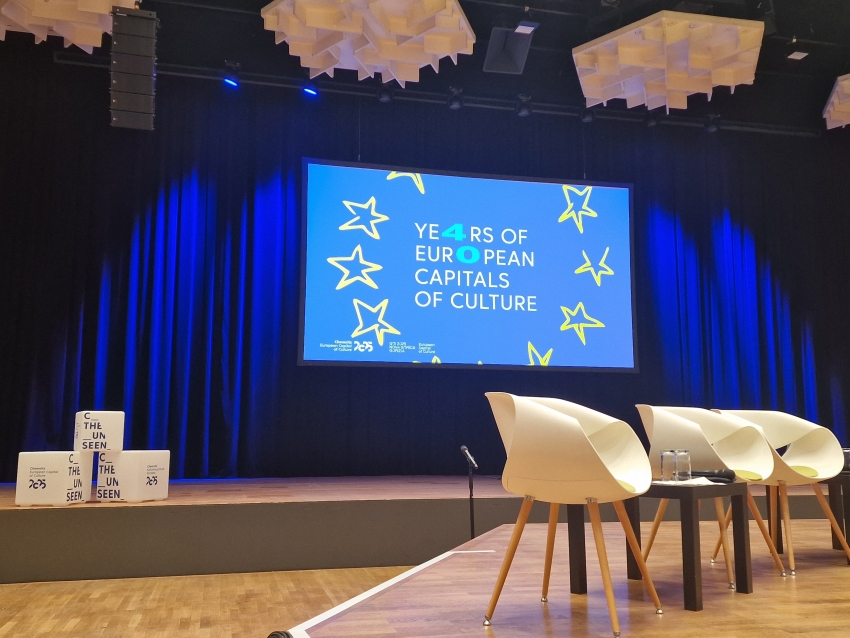
In 2033, when it will be Italy and the Netherlands' turn again to nominate a city, one cycle will end and another will begin. Forty years after the programme was launched, it is time to take stock and, with the help of citizens, to understand how to continue this journey.
Freedom is participation.
You can download the call here.
Below is a summary of the call.
The aim of the call for evidence is to collect input from a wide range of stakeholders on the revision of the ECoC legal basis. This includes views on the main issues identified in the interim evaluation, the relevance of proposed adjustments, and ideas for further improving the initiative’s clarity, effectiveness and alignment with EU priorities. The feedback will inform the final legislative proposal and ensure it reflects the needs and expectations of those directly involved in or impacted by the ECoC action.
What does the initiative aim to achieve and how
The revision of the ECoC legal basis aims to improve the scheme’s selection process, make it simpler and more transparent for applicants and national authorities, and increase its strategic relevance to other EU policies. The changes are designed to build on existing strengths while tackling key issues identified in the summer 2024 public consultation and the interim evaluation.
In practical terms, the initiative will be revised to:
• mainstream the European dimension in all selection criteria;
• better embed key EU priorities into the selection and monitoring phases, such as the green and digital transitions, inclusion, youth engagement, and accessibility;
• reinforce the ‘contribution to the long-term strategy’ criterion and improve evaluation criteria and indicators to bring about longer-term impacts and legacy in the candidate cities;
• simplify the competition’s rules and make them more transparent (selection and monitoring);
• ensure that the expert panel (which carries out the selection and monitoring procedures for applicant and title-holding cities) has the skills and resources to carry out its tasks effectively;
• improve the set of indicators the Commission provides to the organisations responsible for organising the different ECoC competitions;
• build on the knowledge of the 40 years of ECoC: develop capacity building and exchange best practices between past and upcoming title holders;
• consider changes to the rotation of countries holding the title and the size of applicant cities;
• consider a regional approach and the possibility for connections with other parts of the world.
The overall design of the ECoC will not be changed. This will ensure continuity for stakeholders and make the initiative more effective, increase its scalability outside the EU and boost its visibility, in line with the current and future goals of EU cultural policy.
Likely impacts
The proposed revision of the ECoC legal basis is expected to have a positive social, economic, environmental and international impact.
• Social impact. The revised ECoC is expected to strengthen the sense of European identity and belonging, broadening access to and participation in culture. In particular, it will benefit people in rural and less-visible regions and encourage more young people to get involved. It will support social cohesion, intercultural and intergenerational dialogue and democratic engagement in the EU and beyond.
• Economic impact. By improving the visibility and network of ECoC, the initiative is likely to boost local cultural tourism, stimulate innovation and regional development, and create jobs, especially in small and medium-sized cultural businesses.
• Environmental impact. The revised framework will integrate sustainability more explicitly into the selection and monitoring processes, encouraging cities to adopt green practices in management, visitor engagement and operations. This will contribute to raising awareness of climate issues through cultural narratives and boosting the role of culture in advancing the green transition.
• International impact. The revised framework will primarily focus on Member States, as is currently the case, in line with the instrument providing direct financial support to the ECoC at EU level (the Creative Europe programme until 2027 and then its successor). However, EU external action priorities will also be taken into account to ensure that the revised framework play a role in EU enlargement policy, cultural diplomacy and international cultural relations.
UN Sustainable Development Goals (SDGs). The initiative will contribute positively to several SDGs, in particular:
o SDG 4 – Quality education
o SDG 5 – Gender equality
o SDG 8 – Decent work and economic growth
o SDG 10 – Reduced inequalities
o SDG 11 – Sustainable cities and communities
o SDG 13 – Climate action
o SDG 16 – Peace, justice and strong institutions
o SDG 17 – Partnerships for the goals
Future monitoring
The revised ECoC will be supported by a proportionate and structured long-term monitoring framework to maintain quality and track its legacy.
Key aspects of this approach include:
• strengthened post-ECoC year reporting by cities, focusing on implementation of the European dimension, engagement activities and impact on visitors;
• thematic or regional peer-learning sessions, which will serve as both capacity-building and informal monitoring tools by enabling cities to share experiences and highlight good practices;
• possible regular evaluation of the initiative’s legacy supported by independent external assessments.
Target audience
• ECoC managers (former, present and future ones) who can share operational insights from the field;
• ECoC managing authorities in Member States (the respective ministry of culture), responsible for implementation and governance;
• academic experts in the cultural development of cities and the ECoC Expert Panel;
• the general public, including people who have visited or engaged with ECoC and wish to share their views;
• cultural networks, NGOs and civil society organisations involved in culture and cities.
Consultation activities already carried out
• Stakeholder engagement:
o the White Paper ‘40 recommendations from 40 years of ECOC’ was presented and debated in Chemnitz during the 40th ECoC anniversary conference in early April 2025;
o a workshop was organised to discuss the results of the first interim evaluation of the 2020-2033
ECoC action by Ecorys (end of March 2025)
• Consultation with Member States. the White Paper was presented to the European Parliament in May 2025 and the Council’s Culture Affairs Committee in July 2025.
• Document review. Past reports from the ECoC Expert Panel, EU-funded studies and existing monitoring or evaluation data will be incorporated into the evidence base.
------
EcocNews is an independent, non-profit, online newspaper. We cover the world of European and National Capitals of Culture.
Join us on this journey and support us with a voluntary donation here.
