On 4 September, the Mayor of Victoria, Brian Azzopardi, visited Las Palmas de Gran Canaria and met with the city’s Mayor, Carolina Darias, at the City Hall, continuing to build a collaboration that has already moved from dialogue to artistic creation. Accompanied by Joseph Debrincat and Josef Schembri, two members of the Victoria Municipal Council, the Mayor also visited some of the main historical and cultural sites of the capital of Gran Canaria.
The visit follows the meeting held last July in Victoria between Carolina Darias and Brian Azzopardi, when both cities agreed to strengthen their cooperation in areas including contemporary creation, artist mobility and the exchange of experiences. Victoria has already been designated by Malta as European Capital of Culture 2031, while Las Palmas de Gran Canaria is now entering the final stage of the Spanish selection process for the city that will hold the title.
During the official reception at the City Hall, the Mayor welcomed her counterpart from Victoria, who signed the Honour Book of Las Palmas de Gran Canaria. Darias highlighted the importance of sharing experiences during this decisive stage of the candidacy process and stressed the value of Victoria and Las Palmas de Gran Canaria moving forward together towards 2031.
“Today is a very special day for the city of Las Palmas de Gran Canaria because we are welcoming the Mayor of Victoria, from the island of Gozo, Malta, a city that is already European Capital of Culture for 2031,” said Darias. The Mayor added that “we want to share experiences and for the city of Victoria to see how we are preparing, with such commitment and enthusiasm, for this final stage in which we are working to become European Capital of Culture.”
Darias also underlined the intention for the relationship between the two territories to go beyond the selection process itself and develop into shared projects.
“I hope that both Victoria and Las Palmas de Gran Canaria will be European Capitals of Culture in 2031, sharing projects, hopes and the challenges of the future,” she said. In this regard, she recalled the historical links between the Canary Islands and Malta and highlighted that cultural cooperation has already begun to take shape through the participation of two Maltese artists in REBEL WALLS. Urban Stories, at Castillo de Mata. “We have already begun this experience, and hopefully we can take it all the way to 2031 and beyond,” she added.
For his part, the Mayor of Victoria highlighted the similarities between the two islands and the significance for Europe of two island and peripheral territories potentially sharing the European Capital of Culture title.
“We have very similar things on both islands. We have the same strengths, the same difficulties. We believe that the European Union will send a very strong message if they choose Victoria and Las Palmas de Gran Canaria,” Azzopardi said. He argued that selecting both cities would convey a message of a Europe that is open to all its territories, “not only the big countries, cities and regions, but also the small ones like us.” “There is no doubt that choosing both of us would send a very clear message from the European Union,” he added, particularly “at a time when Euroscepticism is becoming stronger.”
Cultural challenges of two island capitals
The cooperation between Las Palmas de Gran Canaria and Victoria-Għawdex is based on an affinity that goes beyond their shared island condition. Both cities face challenges related to connectivity, mobility, identity, their relationship with territory and their geographical position on the margins of the European continent.
In this context, cooperation between the two cities represents an opportunity to transform their peripheral condition into a space for exchange, creation and European connection. The relationship takes on particular significance given the possibility that, in 2031, Victoria and a Spanish city could share the title of European Capitals of Culture.
The Mayor of Victoria’s programme also included a tour of Vegueta, one of the key areas for understanding the history of Las Palmas de Gran Canaria. The guided tour, led by cultural communicator Dieguito Flores, explored the heritage, stories and transformations of one of the city’s historic districts.
The tour also provided an opportunity to connect the history of Las Palmas de Gran Canaria with the longstanding historical links between the Canary Islands and Malta. The Maltese presence has been part of the city’s history for centuries and remains visible, among other places, in the street names around Triana, including Calle de Los Malteses.
Artistic collaboration through REBEL WALLS
The visit continued at the Castillo de Mata Museum, a heritage site that in recent months has become one of the main spaces for cultural experimentation connected to LPGC’31.
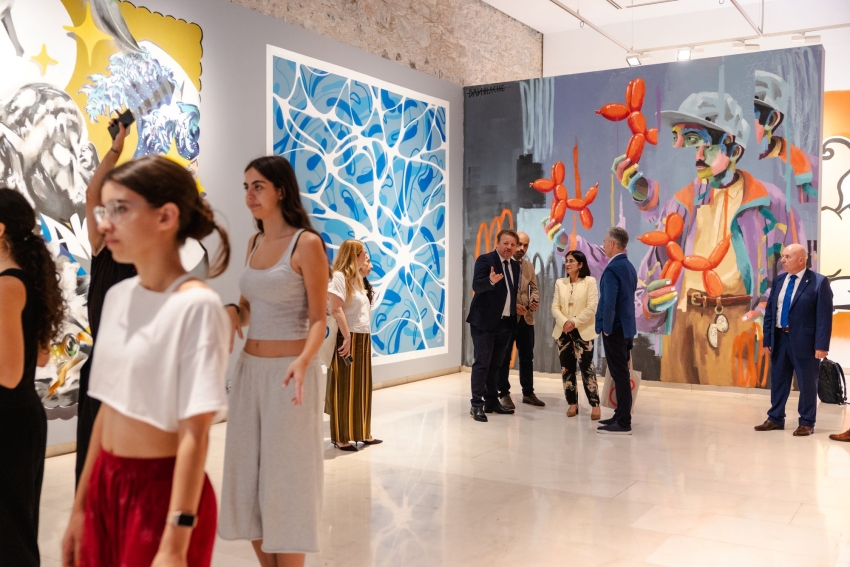
There, the Maltese delegation visited REBEL WALLS. Urban Stories, a project that presents urban art as a contemporary cultural expression and as a tool for participation, transformation and the construction of collective identity. The exhibition brings together interventions by 14 urban artists, transforming the walls of Castillo de Mata into a space for creation and dialogue with new forms of culture.
The visit to Castillo de Mata was particularly significant as it allowed the Mayor of Victoria to see the outcome of the first artistic collaboration between the two cities within the framework of their respective cultural projects for 2031.
In August, Maltese artists Jason Joe Farrugia and Cynthia Saliba, from the island of Gozo, took part in an artistic residency in Las Palmas de Gran Canaria linked to REBEL WALLS. Urban Stories. Both artists created new mural interventions at Castillo de Mata, bringing two perspectives from the Mediterranean into the exhibition and strengthening the international dimension of the project.
The residency resulted from the agreements reached between LPGC’31 and Victoria-Għawdex 2031 during the meetings held between the two cities in recent months. For the Las Palmas de Gran Canaria candidacy, this exchange represents a concrete way of turning European cooperation into real projects capable of generating mobility, shared knowledge and connections between creative communities.
The experience of Farrugia and Saliba also opens the door to new collaborations between the two territories, both in the field of artistic residencies and in other areas related to contemporary creation, heritage, citizen participation and urban culture.
Two islands, one shared European perspective
The visit by Brian Azzopardi forms part of LPGC’31’s international strategy and the candidacy’s commitment to building European alliances from the very beginning of the preparation process for the European Capital of Culture.
The relationship with Victoria-Għawdex takes on particular significance given the possibility that, in 2031, a Spanish city and Victoria could share the title of European Capitals of Culture. The cooperation initiated between the two cities seeks to anticipate this possible scenario by building projects and cultural relationships from now on.
The alliance between the two cities will continue to develop over the coming months through further exchanges and joint projects, consolidating a relationship that has already moved beyond declarations of intent towards shared artistic creation.