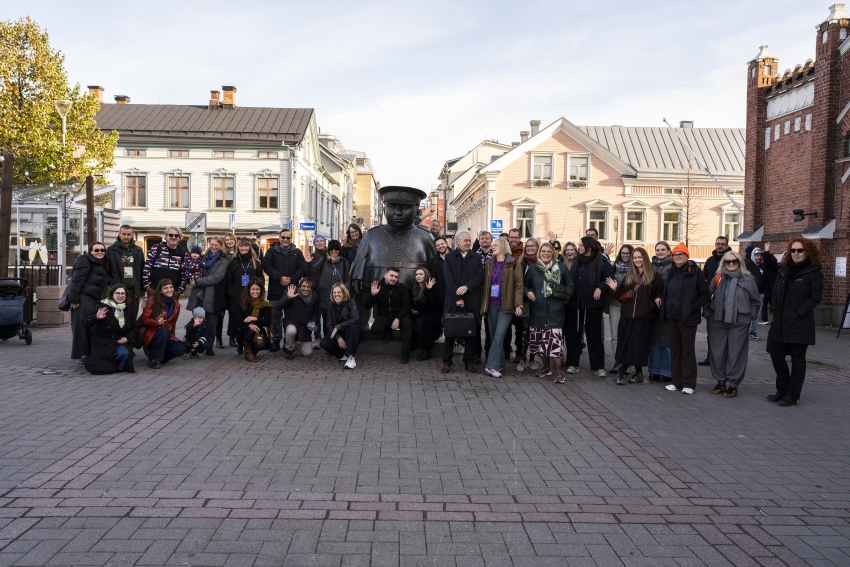
Human relationships are, above all, what every Culture Next conference is about. Culture Next is a network of more than 50 European cities, some of which won the title of European Capital of Culture and some of which did not.
More and more, Culture Next is not just a network but a community of people, projects, ideas and smiles. Each member plays an active part in a mosaic, a collective trying to shape Europe's future by putting its core values first: equality, inclusion and sustainability.
Once again, at the 17th Culture Next Conference, EcocNews was there as the network's media partner, alongside more than 50 cities.
The conference brought three days of discussion and debate on sustainability in its many forms, from environmental to economic. The question was how it can move beyond the statements found in every bid book and become long-term practice, keeping pace with the Sustainable Development Goals of the ONU 2030 Agenda.
The eve of the conference featured an informal exchange with Glenn Micallef, European Commissioner for Intergenerational Fairness, Youth, Culture and Sport, on the proposed new legal basis for the European Capitals of Culture. Mari-Leena Talvitie, Finland's Minister of Science and Culture, and Piia Rantala-Korhonen, CEO of Oulu2026, also took part. The discussion was moderated by Ștefan Teișanu, Secretary General of Culture Next. Teișanu later retraced the history of the network, born almost ten years ago from cities determined to carry on the projects in their bid books even without winning the title.
Proceedings opened at Pikisali in the Oulu Theatre with Mayor Ari Alatossava: "In recent months, Oulu has seen a clear rise in tourism figures: more visitors, more overnight stays, more revenue. Culture is a source of wellbeing and, at the same time, an economic engine." Henri Turunen, Culture Next Board Member and Programme Manager of Oulu2026, described a programme built as a journey through the seasons. It runs from the frozen sea of Brave Hinterland to the Summer Night Dinner, a kilometre-long table for twenty thousand people, all the way to the exhibition dedicated to Björk.
Andràs Farkas, Culture Next Advocacy and Groups Coordinator, brilliantly guided the entire three-day programme of meetings and brought together guests, ideas and presentations.
Rantala-Korhonen explained how sustainability unfolds across environmental, economic and social dimensions. Examples include existing buildings repurposed instead of new ones being built, the Arctic Food Lab with 200 companies, and some 700 projects generated by the We Are Culture open call. Then there is the Kaiku Card, which opens theatres and concerts to people facing financial hardship. "What you see is only the surface," they insist in Oulu: underneath lie skills, spaces and relationships built to last.
From Manchester, Paula Stringer, Chief Operating Officer at Factory International, outlined a fifty-year ambition. She asked simple questions: who makes the work, who benefits from it, what skills does it leave behind, and what remains once the work itself is gone? A panel moderated by Beatriz Garcia brought together John Crowley (PHGD Group), Joana Miranda (Braga Media Arts) and Fredrik Lindencrona (Inner Development Goals), who looked beyond the environmental dimension. Climate data is not enough if we do not understand people, and without history, philosophy and anthropology, green laws remain words on paper. Rather than becoming a "Goal 18", culture could fill the conceptual gap at the heart of the SDGs.
A second panel, moderated by Marilyn Gaughan-Reddan, brought together Kati Romics (Ars Electronica Solutions), Veronika Majíčková and Lukáš Pavlica (City of Brno) and Evi Gillard (LOV2030 – Leuven & Beyond). It emerged that few cities actually use the goals in their strategies and bids. The proposal is to treat them not as an extra reporting layer, but as a framework for building partnerships.
Three years of work by the SDG Innovation Lab have come together in Encore, presented by Ralf Alwani of Whitelabel. It is an artificial intelligence trained only on the network's own documents, designed to bring order to fragmented evidence: cities had brought more than 3,000 indicators, now reduced to 6 themes and 26 indicators. It will be available to member cities on the Culture Next website.
For the first time, the conference looked beyond Europe. François Menguelé, Secretary General of UCLG Africa, described the shared past of Africa and Europe as a heritage on which to build new alliances. Hugues Gervais Ondaye presented Brazzaville–Kinshasa, African Capitals of Culture 2026–2027, the first joint edition of the programme, on the two banks of the Congo River. Jaemin Shin, Creative Director at the Chungju Culture and Tourism Foundation, introduced the Korean K-City of Culture model. Jiro Kogi of EU-Japan Fest,Culture Next partner, joined by Yosiko Swinney, Rika Uechi and Kota Akabane, presented projects in Nagano and Okinawa: "We want to strengthen this bridge even further, convinced as we are that the exchange of knowledge is the foundation of every cultural infrastructure." During the internal session Next on Culture Next, the discussion also covered the opportunities offered by the media partnership with EcocNews.
Finally, the floor turned to the issue of issues: legacy. Sille Talvet-Unt, Lead Coordinator of ECoC Echo at Foundation Tartu 2024, presented a project bringing together 9 countries and 86 organisations. It reads legacy through five dimensions: institutional, infrastructure, emotional, programme and financial. Professor Rafaela Neiva Ganga, Chair of the ECoC Monitoring & Evaluation Network, showed how fragile evaluation still is: only 7 of 18 respondents evaluate legacy in depth after the title year.
The next appointment is in České Budějovice, Czechia, from 10 to 12 March 2027.
The network also announced the second edition of the ECoC Summit, to be held at the European Parliament on 2 December 2026, with further details and registration to be published soon.
Mariateresa Cascino - Editor in Chief
Serafino Paternoster - Editorial director