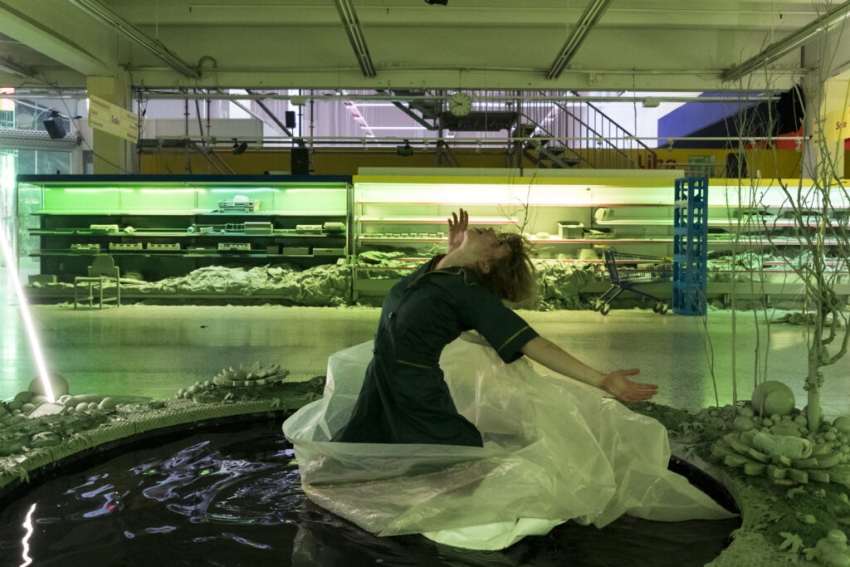
At ECoCNews, we had the opportunity to experience the performance firsthand, and the immediate impression was that of entering a parallel universe where genius and disorder coexist, and where the boundary between reality and imagination is constantly challenged. The abandoned building that once housed one of the city’s most important commercial hubs is transformed into a living organism inhabited by mythological figures, music, installations, enigmatic presences and performative actions that seem to emerge from its very walls.
There is no auditorium here, nor any privileged viewpoint from which to observe the action. Instead, visitors encounter countless possible routes, rooms, encounters and detours. Spectators are compelled to make continuous choices. Should they follow a melody drifting through a corridor, or enter a dimly lit room? Stay with a character, or abandon them in pursuit of another suggestion?
The consequence is clear: no two people actually see the same performance.
This freedom is both the work’s greatest strength and its most significant limitation.
On the one hand, Faravid’s Land achieves something traditional theatre can rarely offer: a genuine sense of discovery. Audiences do not watch a story unfold before them; they explore a narrative landscape. The spectator is no longer merely a recipient but a builder of meaning.
On the other hand, such fragmentation inevitably comes at the cost of dramatic cohesion. Some sequences are remarkably powerful and remain vivid in memory; others risk becoming isolated episodes, evocative yet lacking narrative development. It is a risk many immersive productions consciously embrace, sacrificing linear storytelling in favour of experiential intensity.
The setting itself plays a decisive role in the work’s impact. The former supermarket is not merely a venue. It becomes narrative material.
Its decaying spaces, empty corridors and fading signs create an almost archaeological atmosphere. One senses the memory of a place that was once central to community life and is now awaiting demolition. In this sense, Faravid’s Land speaks less about the Nordic mythology embodied by its characters and more about urban transformation, loss and regeneration.
The tension between past and future permeates the entire experience. On one side stands a building marked by abandonment; on the other, the promise of a new arena dedicated to entertainment and leisure. In between, theatre temporarily occupies the space and transforms it into a site of collective reflection.
It is here that the work assumes a political dimension, despite avoiding any explicit political statement.
From an aesthetic perspective, several artistic references emerge. At times, entering certain spaces feels like stepping into the visionary circus of Federico Fellini, populated by eccentric figures and a humanity suspended between the grotesque and the poetic. At other moments, a quieter and more melancholic sensibility evokes the cinema of Krzysztof Kieślowski, where meaning resides in details, silent presences and seemingly marginal fragments.
Yet perhaps the most interesting aspect is not the sum of these influences but their collision. Faravid’s Land constantly oscillates between order and chaos, celebration and melancholy, myth and everyday life. It is a work that appears to reject coherence as an absolute value, choosing instead to inhabit contradiction.
The actors, dancers, musicians and circus performers further enrich the journey. Their technical skill is undeniable, but what impresses most is their ability to transform every environment into a narrative possibility. There is no centre of action because action exists everywhere. Each visitor inevitably creates a personal version of the performance, shaped by discoveries, missed opportunities and individual interpretations.
Not everything works equally well. At times, the sheer volume of stimuli becomes overwhelming. The overlap of theatre, contemporary dance, circus arts, sound installation and participatory performance can create a sense of saturation. Spectators may occasionally find themselves more occupied with navigating the space than engaging deeply with what surrounds them.
But perhaps that is precisely the point.
Faravid’s Land does not guide its audience towards a conclusion. Rather, it forces them to confront uncertainty and the possibility that something important has been missed behind a recently closed door or in a room never entered. It is a work built upon incompleteness, and for that very reason it lingers in memory long after it ends.
The conclusion, however, offers an image capable of symbolically gathering together the performance’s many trajectories. After wandering through decaying environments, mythological landscapes, grotesque apparitions and moments of profound intimacy, spectators are called back into a shared space. Here, the company gathers around a large technological totem, a luminous presence that dominates the scene and becomes the focal point of the final act.
It is a far from neutral choice. In anthropological traditions, a totem functions as the symbol that identifies and unites a community, embodying shared values, memories and belonging. In Faravid’s Land, this archetype is reimagined through a technological object, seemingly suggesting that contemporary societies have replaced ancestral symbols with new forms of collective faith. If the performance’s journey is populated by mythical creatures, Nordic spirits and echoes of a distant past, its final destination points towards a new dominant mythology: technology as a place of gathering, a promise of the future, and an object of reverence.
It is a deliberately ambiguous image. On one hand, it marks the moment when a community dispersed throughout the immersive experience reunites. On the other, it introduces a critical reflection on our times, questioning the relationship between innovation, identity and belonging. The future awaiting Raksila, with its planned experience arena and new forms of collective entertainment, suddenly materialises before the audience's eyes.
In a cultural landscape where many productions strive to be immediately accessible and easily decoded, this choice feels courageous. Not always comfortable, not always entirely resolved, but unquestionably radical.
More than telling a story, Faravid’s Land creates a condition. The question that remains while leaving the former Raksila supermarket concerns not only happiness, the work’s declared theme, but the very meaning of contemporary cultural experience: do we still want to be spectators, or are we prepared to accept the risk, and the responsibility, of becoming explorers?
And above all: around which new totems are we choosing to gather as communities?
Faravid’s Land offers no answers. Yet in its continuous oscillation between ruin and renewal, memory and future, myth and technology, it succeeds in asking the right questions. At a time when much cultural production seems primarily concerned with reassuring audiences, that is no small achievement.
Other info here.
When and where
Summer 2026 (May-Aug), Autumn 2026 (Sep-Dec)
Oulu
Organisers
Oulu Theatre, Flow Productions, In collaboration with Oulu2026, Oulu August Festivals and still still (NED). Financial supporters: Oulu2026, The Finnish Cultural Foundation