



Online newspaper based in Matera
EcocNews is registered at the Court of Matera in the press register n. 2/2021
Editor in chief: Mariateresa Cascino. Founder and editorial director: Serafino Paternoster
via San Francesco, 1 - 75100 Matera (Italy)



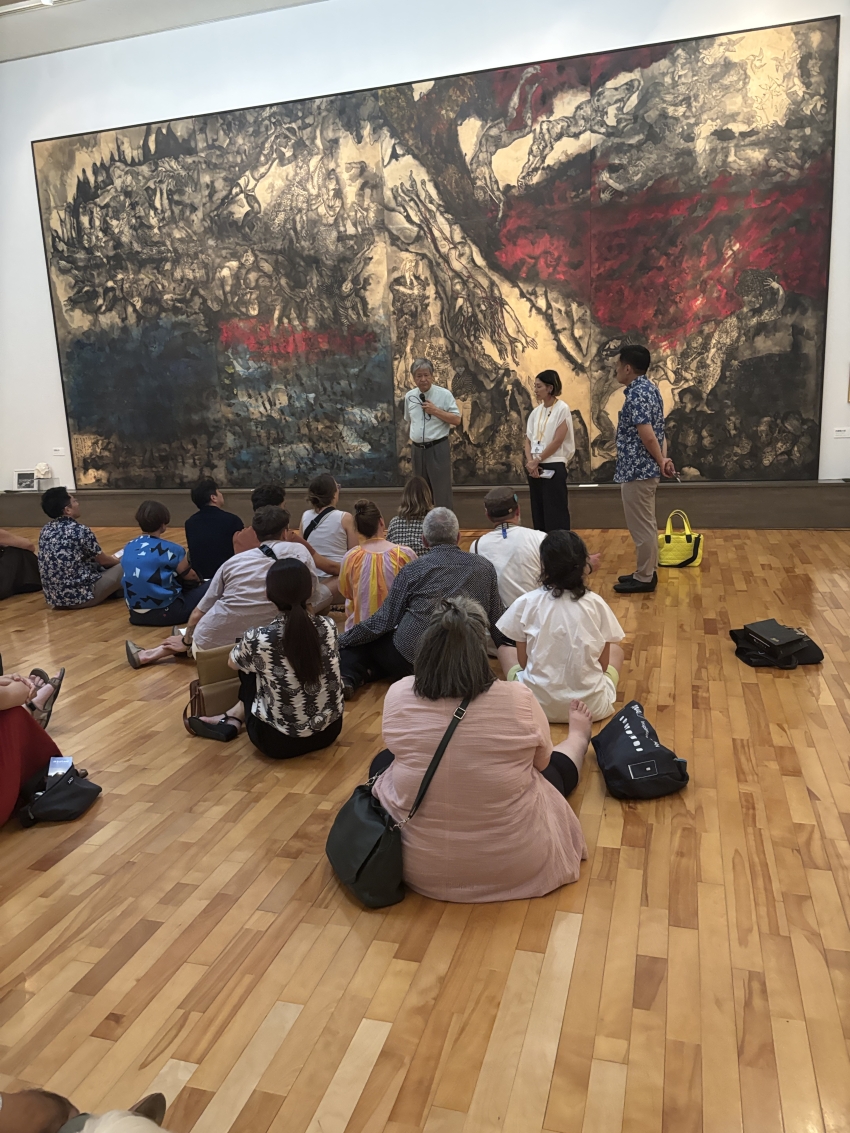 Looking at "The Battle of Okinawa", a large and dramatic painting (400 cm x 850 cm) at the Sakima Art Museum
Photo by Alberto Giordano / EcocNews
Looking at "The Battle of Okinawa", a large and dramatic painting (400 cm x 850 cm) at the Sakima Art Museum
Photo by Alberto Giordano / EcocNews
Okinawa. In the far south of Japan. An independent archipelago until almost the end of the 19th century. Still with great aspirations for autonomy. Scene of one of the bloodiest battles of the Second World War. Occupied by the United States until 1972, with a massive American military presence that was not exactly well received by the local population.
As we wrote in the previous article, that terrible battle, which saw thousands of deaths, mostly Japanese and especially locals, left repercussions that are still deeply felt in the spirit of the Okinawans.
As soon as we landed in Naha, we were immediately transported to the Okinawa Prefectural Museum & Art Museum, the largest cultural facility in the Prefecture that combines a museum and an art gallery, affectionately known as Okimyu. The museum's theme is "Living in the Sea and on the Islands" and unravels the nature, history, and culture of Okinawa. Beginning with the approach with coral reefs underfoot, visitors can learn about the birth and fall of the Ryukyu Kingdom, from postwar Okinawa to the future. Another highlight is the outdoor exhibit with traditional takakura and minka houses.
On the other hand, the museum focuses on paintings such as oil paintings and watercolors, sculptures and other three-dimensional art forms nurtured in the Okinawan climate, as well as visual arts (films, video works, etc.), exhibiting mainly modern and contemporary art works from Japan and other Asian countries.
A deep breath and, after a very short journey, we were accompanied to the symbol of the Ryukyu kingdom, a monarchial state that existed for 450 years, from 1429 to 1879.
In the Battle of Okinawa in 1945, Shurijo Castle was left in ruins but in 1992, commemorating the 20th year since Okinawa's reversion to Japan, Shurijo Castle was restored and opened as a national park.
Noted for its cultural and historical significance in the distinctive archaeological style that combined the structural cultures of both China and Japan, as well as the high skills in the stonework, Shurijo Castle was registered as Japan's 11th World Heritage Site in December of 2000.
The stately appearance of Shurijo Castle with its brilliant vermilion color speaks of the great history and culture of the proud kingdom, and symbolizes Okinawa.
Shurijo Castle burned down a total of three times during the Ryukyu Kingdom era, and was heavily damaged after the islands of the kingdom were incorporated into Japan as Okinawa Prefecture. The castle burned down again during World War II, but was restored in 1992.
In 2000, the Gusuku Sites and Related Properties of the Kingdom of Ryukyu, which includes Shurijo Castle, earned UNESCO World Heritage status. Although areas of Shurijo Castle continue to be restored and opened to the public, another terrible fire in October 2019 resulted in the complete destruction of the Seiden main hall, and other important castle buildings. Restoration work is underway and we were able to observe the final details of the meticulous reconstruction before the next reopening of the castle to the public.
The understanding of the memory of the war that still pervades the population was perfected in the visit we made the following day to the Sakima Art Museum. The Sakima Art Museum lies literally centimeters away from the Marine Corps Air Station Futenma in Ginowan. In fact, the land it is on used to be a part of the Air Station before it was returned. The museum opened in 1994, with the main focus of bringing a message of peace.
The permanent exhibition there is a collection of paintings by a famed husband and wife pair, Iri and Toshi Maruki. Together they painted gigantic art pieces portraying the horrors of war. The highlight of the series, titled “The Battle of Okinawa,” measures four by eight and a half meters and its sheer size and in-your-face stance seem to remind us that there is no escaping the tragedies of war.
The couple was from mainland Japan, but they went to great lengths to research and prepare for this series of paintings. This is evident in their detailed depictions in each of the 10 or so paintings, which are mostly dominated by dark, somber colors. In the museum’s catalog (available for purchase at the museum), Iri Maruki said, “We have painted Hiroshima, we have painted Nanking, we have painted Auschwitz but in painting Okinawa, we are truly painting war.”
The theme throughout the Museum's collection is “people and war,” “life and death,” and “anguish and salvation.” The structural features of the Museum are based on and inspired by Okinawa, designed so that there is a sense of oneness with the Kamekobaka, the turtle-back tomb, in the garden (built circa 1740) where my ancestors are laid to rest, and the square opening at the top of the flight of stairs leading to the roof designed to meet the sun setting in the horizon on June 23 (Okinawa Memorial Day).
The Director of the Museum, Mikio Sakima accompanied us on the visit: “It is my wish that this Museum will be the “shade of trees” for the hearts and souls of the visitors, and to offer “a place of thoughts” where people can spend their time deep in their thoughts.Designed by Okinawan architect Yoshikazu Makishi, the Sakima Art Museum is also worth visiting for its architecture. The rooftop is accessible to the public and I think the best view is when you are on an eye-level with the square hole at the top of the flight of stairs.” “My desire was to create “a space for thoughts” in Okinawa, a place where people could calm their souls and placidly let themselves become deeply absorbed in thought”.
Mikio Sakima illustrated the gigantic painting in detail, making us understand every detail that the artists created based on the testimonies of people who lived through the battle of Okinawa and who were used as models.
“The Battle of Okinawa” depicts human destruction in war, drawing on the experiences of the inhabitants of Okinawa, the only place in Japan to have experienced land battles. The Marukis hope that “people will seriously reflect on this and embark on a path toward a history that does not include war.”
Director Sakima recalls Maruki Toshi’s words when describing the moment of creating the work: “I want to paint the deep, deep blue of the sea: And the emerald green of the reef dyed orange as the young girl sank beneath its waters. Crimson, vermilion, is it the flowing blog of the youth? Is it the flames that chased the who ran desperately? Either way, both are true.”
We then went up to the Museum’s rooftop. After going up the first steps, you'll see odd numbered steps: first 6 and then 23. These numbers were chosen to represent June 23rd, the Memorial Day for the dead during the Battle of Okinawa, 3-6 March 1945. After the steps, you'll see a tiny portion of the base. Just below the building, you will see a couple of Okinawan-style grave stones. Because these are located inside the base, the families need to make a request to the U.S. military in order to pay respect their own ancestors.
With these thoughts that try to look increasingly towards a world of peace, but which cannot forget what has been, we'll meet you in the next article on "Meet Up Ecoc Face to Face 2026.

Alberto Giordano lived different lives crossing fields and places.
Online newspaper based in Matera
EcocNews is registered at the Court of Matera in the press register n. 2/2021
Editor in chief: Mariateresa Cascino. Founder and editorial director: Serafino Paternoster
via San Francesco, 1 - 75100 Matera (Italy)