

Online newspaper based in Matera
EcocNews is registered at the Court of Matera in the press register n. 2/2021
Editor in chief: Mariateresa Cascino. Founder and editorial director: Serafino Paternoster
via San Francesco, 1 - 75100 Matera (Italy)



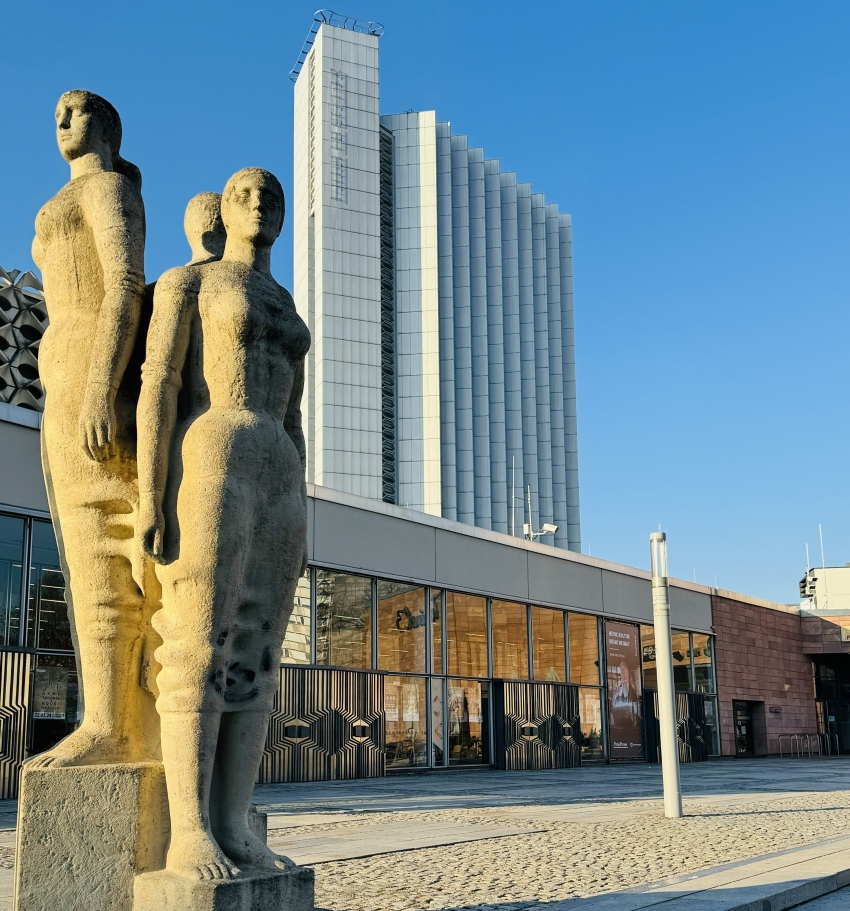 Stadthallenpark with Sculpture Garden (Chemnitz, Germany)
Photo by EcocNews
Stadthallenpark with Sculpture Garden (Chemnitz, Germany)
Photo by EcocNews
Why every future European Capital of Culture needs a legacy plan before the title year even starts.
A new video, produced within the European network ECoC Echo, brings together nine former, current and future European Capitals of Culture to answer two questions: what they want their legacy to achieve, and what the biggest challenge is in making that legacy last. The video is a call to future title-holders — including Liepāja (2027), Évora (2027) and Bourges (2028) — to start thinking about legacy early, rather than after the celebrations end.
ECoC Echo is an Interreg Europe project set up precisely because that question — how do you keep the impact of a title year alive once the spotlight moves on — is one every European Capital of Culture eventually has to answer, often without a ready-made playbook. The network exists to change that: to turn individual experiences into shared, transferable knowledge. Its nine members are Leeuwarden-Fryslân (2018), Novi Sad (2022), Veszprém-Balaton (2023), Tartu (2024), Chemnitz (2025), Oulu (2026), Liepāja (2027), Évora (2027) and Bourges (2028).
One of the network's stated ambitions is to develop a shared toolbox: a practical resource that future European Capitals of Culture can use to build their own legacy strategy from the ground up. As Immie Jonkman, director of Arcadia — the legacy programme of Leeuwarden-Fryslân 2018 and one of the network's participating organisations — points out, one of the clearest lessons from the network so far is that a legacy plan needs to be in place before the title year begins, not developed afterwards as an afterthought.
From 19 to 21 May, the network met in Novi Sad, Serbia, itself European Capital of Culture in 2022, for a three-day exchange on international cooperation, urban transformation, the decentralisation of culture and sustainable legacy management. Participants visited several renovated cultural venues across the city and met with representatives of past, current and future European Capitals of Culture. Earlier seminars in the series took place in Veszprém and Leeuwarden; following Novi Sad, the next will be held in Chemnitz.
For cities preparing for or considering a future ECoC title, the network's message is straightforward: legacy is not something that happens automatically once the funding and programming for the title year are in place. It takes deliberate planning, and that planning starts well before the opening ceremony.
The video is available here.
About ECoC Echo
ECoC Echo is a project co-financed through the Interreg Europe programme, connecting nine former, current and future European Capitals of Culture — Leeuwarden-Fryslân (2018), Novi Sad (2022), Veszprém-Balaton (2023), Tartu (2024), Chemnitz (2025), Oulu (2026), Liepāja (2027), Évora (2027) and Bourges (2028) — around a shared question: how do you build and sustain the legacy of a European Capital of Culture beyond its title year?

He tries to make photography an art and writing a profession. He studies at the European Institute of Design in Turin. He is passionate about soccer, so don't touch his Inter.
Online newspaper based in Matera
EcocNews is registered at the Court of Matera in the press register n. 2/2021
Editor in chief: Mariateresa Cascino. Founder and editorial director: Serafino Paternoster
via San Francesco, 1 - 75100 Matera (Italy)