

Online newspaper based in Matera
EcocNews is registered at the Court of Matera in the press register n. 2/2021
Editor in chief: Mariateresa Cascino. Founder and editorial director: Serafino Paternoster
via San Francesco, 1 - 75100 Matera (Italy)



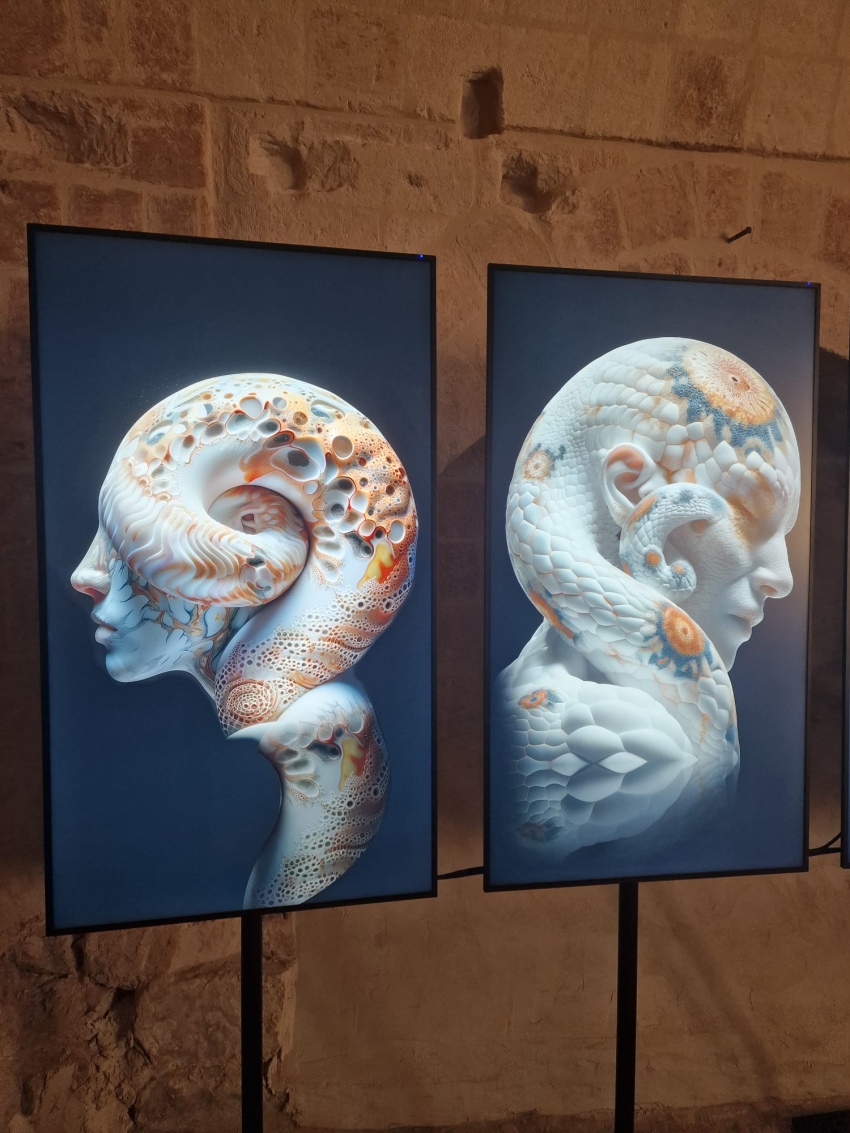 Baris Gencel, The Forgotten Sea & Memory of Stone,
Photo by EcocNews
Baris Gencel, The Forgotten Sea & Memory of Stone,
Photo by EcocNews
Seven years after its year as European Capital of Culture, and when Matera is Mediterranean Capital of Culture and dialogue for 2026, the city of the Sassi asks what it means to be Mediterranean without a coastline. The answer comes from nine artists, four museums and a walk across the old town – until 8 December 2026.
Stand on the edge of the Sasso Caveoso on a clear autumn morning and look out over the ravine of the Gravina: what you see is rock, scrub and sky. The nearest beach, on the Ionian coast, is the best part of an hour's drive away. And yet the honey-coloured stone under your feet was born underwater. The calcarenite into which Matera's cave dwellings, churches and cisterns were carved is a sedimentary rock, made of the shells and skeletons of creatures that lived in an ancient sea. The sea has not gone anywhere; it has simply turned to stone.
This is the intuition behind THE SEA IS CLOSER THAN YOU SEE, the group exhibition that opened on 3 October and will run until 8 December across four venues in the historic centre. It is one of the flagship projects of TERRE IMMERSE, the programme with which Matera is living its year as Mediterranean Capital of Culture and Dialogue 2026 – a title that inevitably invites comparison with 2019, when the city held the European Capital of Culture title and transformed its relationship with contemporary culture.
The exhibition is curated by Chiara Canali, working with Simona Spinella, and brings together Studio Azzurro, Andrea Crespi, Martin Romeo, Valentinaki, Leonardo Antonio Avezzano with Valentin Ammann, Baris Gencel, Giuseppe La Spada, Silvio Giordano and Julius Horsthuis. Between them they cover video installation, photography, holography, sound, generative art, artificial intelligence, computer vision and immersive environments. Behind the project are the Matera Basilicata 2019 Foundation – the body born out of the 2019 Capital year – and the Municipality of Matera, with the support of the Ministry of Culture, in collaboration with the National Museums of Matera, the Basilicata Regional Promotion Agency (APT), and the MUSMA and TAM museums. The embassies of Cyprus and Latvia, home countries of two of the artists, have granted their patronage.
Belonging to a sea you cannot see
The question at the heart of the show sounds almost naive: how far can the sea really be from a place that belongs so deeply to the Mediterranean? It echoes one of the founding statements of the TERRE IMMERSE dossier, which argues that direct access to the water is not a condition for Mediterranean identity. The Mediterranean, in this view, is not a strip of coast but a network: of trade routes and migrations, languages and religions, techniques, economies and memories, reaching far inland along valleys and sheep tracks.
Matera is an ideal place to test the idea. Beyond its geology, the city's history is one of water management in a dry land – cisterns, channels and underground collection systems built over millennia, which today are among its most visited sights. The title of the exhibition is therefore not a promise of a sea to be reached, but a reminder of one that is already present: inscribed in the stone, in images and bodies, in the journeys of people who left and arrived, and, increasingly, in the invisible flows of data that cross the region.
Canali's main point of reference is Franco Cassano's Pensiero meridiano ("Southern Thought"), the influential essay by the Bari-born sociologist that invites us to look at the South not as a lagging periphery but as a place with its own way of thinking. Cassano reminds us that the word Mediterranean literally means "in the midst of the lands": a sea that connects rather than separates. From that perspective, distance from the coast is not distance from the Mediterranean, and Matera becomes a kind of archive-city in which different times, cultures and geographies are layered on top of one another.
Two other classics complete the frame. Peregrine Horden and Nicholas Purcell's historical work describes the Mediterranean as a patchwork of small, distinct micro-ecologies bound together by constant connections – a description that fits the landscape of Basilicata well. Predrag Matvejević's Mediterranean Breviary, meanwhile, suggests looking at concrete traces: ports, words, objects, buildings, rituals, materials and paths. It is this concrete, material Mediterranean that the exhibition sets out to show.
Which is also why the show deliberately refuses the postcard. There is very little blue water and no tourist horizon here. Instead there are deserts and fossils, stones and bodies, an artificial cloud, prehistoric rock paintings, communities on the move, and waters flowing through very different territories. The four themes of TERRE IMMERSE – Stratifications, Isolations, Contaminations and Transhumance – become four ways of reading this plural, layered and sometimes conflictual Mediterranean: as geological and cultural sediment, as a tension between centre and periphery, as a space of encounter and hybridisation, and as a stage for the movement of people, languages and knowledge.
A walk from stone to data
One of the most interesting choices is the format itself. Rather than gathering everything under one roof, the exhibition is spread across four institutions, so that the city becomes part of the show. Moving between Palazzo Lanfranchi, MUSMA, the TAM and the APT's space in Palazzo dell'Annunziata means walking between the Sasso Caveoso and the Piano, the upper town built in later centuries, and crossing the rocky divide that separates them. The curators describe the route as a passage from stone to data, from memory to landscape, from matter to the digital. Water is the thread that runs through it, but it never appears in the same form twice.
Palazzo Lanfranchi: water as a map, Lucania as a question
The journey starts in the former seminary of Palazzo Lanfranchi, home of the National Museum of Medieval and Modern Art of Basilicata, in the two rooms dedicated to the Levi and D'Errico collections. Here Giuseppe La Spada presents WATER: Always different, always the same (2026), a video installation that gathers fifteen years of his footage of water and reassembles it into a kind of liquid map, linking the waters of different Mediterranean cities and territories. The work has a second layer: La Spada runs his images through computer vision and motion analysis, turning them into data on speed, trajectory, flow and turbulence. Two ways of knowing water sit side by side – the sensory gaze of the human eye and the analytical gaze of the machine.
In the D'Errico Room, Silvio Giordano takes on one of the most loaded images in Basilicata's cultural history. Lucania 2026 enters into dialogue with Carlo Levi's monumental painting Lucania '61, the panoramic work in which the author of Christ Stopped at Eboli celebrated the peasant world gathered around the poet Rocco Scotellaro. Giordano uses artificial intelligence not simply to retouch that picture but to open a temporal rift within it: where Levi painted a dense, collective community bound to the land, the present-day version speaks of dispersion, depopulation and emigration, and asks what the future of the region might look like.
TAM: a fossil memory
At the TAM – Tower Art Museum, whose route unfolds over two sites in the old town, the Cypriot artist Baris Gencel presents The Forgotten Sea & Memory of Stone. Gencel uses AI to reinterpret Matera's geological and marine past, producing images in which human faces gradually become coral, shell, mineral and organism. The result is an imaginary archive of marine, fossil and biological forms, and a visual genealogy that ties together body, water and the stone of the city.
MUSMA: hands, myths and clouds
The richest stop is MUSMA, the Museum of Contemporary Sculpture, set in the cave spaces of Palazzo Pomarici in the Sasso Caveoso. Here the relationship between matter, memory and technology takes several different shapes.
Studio Azzurro, the Milan collective that pioneered Italian video art and interactive installation, presents Il Colore dei gesti. Sinfonia Mediterraneo (The Colour of Gestures: Mediterranean Symphony), a large fresco of sound and image built from the gestures of work. The hands of fishermen, luthiers, potters, weavers and other artisans become a shared language that crosses cultures and borders, portraying the Mediterranean as a common heritage of skills, signs and memories.
Andrea Crespi's Thetis, a project promoted by the One Ocean Foundation and ZEITGEIST19, is a holographic presence inspired both by the jellyfish and by Thetis, the sea nymph of Greek myth and mother of Achilles – a figure suspended between nature, legend and technology. The Latvian artist Valentinaki brings Liquid Blue, an environmental sculpture in wood, resin and pigment conceived as a living, vibrating body; combined with a soundscape by Nikola Negorod and Glauk Sound technology, it turns the liquid element into physical vibration and sound waves that visitors can feel as well as hear.
Martin Romeo's Anthropic Cloud is a cloud made of Murano glass, wood and electronics. Fed with flight-path data, it makes perceptible the air traffic that constantly crosses the sky above us, and the atmospheric changes produced by human activity. It is one of the works where the exhibition's approach to technology is clearest: a global, invisible infrastructure is translated into a local and almost intimate experience.
The MUSMA section ends far from Basilicata, in the Algerian Sahara. TEMET, by Leonardo Antonio Avezzano and Valentin Ammann, grew out of field research at Tassili n'Ajjer, a UNESCO World Heritage site famous for its prehistoric rock art. Combining photography, documentation, advanced imaging technology and the knowledge of Tuareg communities, the project brings ancient paintings back to light and uses them to tell a long history of migration and cultural and commercial exchange between Africa, Europe and the Mediterranean. It is a reminder that the Mediterranean also extends into the desert.
Palazzo dell'Annunziata: into the fractal deep
The last stop is the Basilicata Open Space run by the APT in Palazzo dell'Annunziata, on Piazza Vittorio Veneto, at the heart of the Piano. Here the Dutch digital artist Julius Horsthuis, known for his fractal films, presents Foreign Nature (2022), an immersive environment generated through fractal art. Coral-like structures, abyssal landscapes and cosmic configurations unfold around the viewer, blurring the line between natural and artificial, microcosm and macrocosm – an ocean floor that is also, in some sense, a galaxy.
Artificial intelligence, without the hype
In a year in which artificial intelligence dominates the cultural debate, it would have been easy to build an exhibition around the novelty of the tools. THE SEA IS CLOSER THAN YOU SEE takes a different line. Here the digital is less a theme than a method: a way to make perceptible what normally escapes direct experience – air and water flows, climate change, data, lost memories, images erased by time.
The works mentioned above show the range of approaches: La Spada sets the computational eye against the human one; Romeo turns flight data into a tool for environmental and geopolitical awareness; Gencel uses AI to give form to the geological memory of a city; Giordano uses it to measure, almost painfully, the distance between Levi's Lucania and today's. In each case the technology is put at the service of a question about memory, identity, the environment or social change.
The curators frame AI as a new language rather than a miracle or a threat, and suggest a final analogy that sums up the spirit of the project. Just as water connects distant territories, data now connects distant places; just as memory leaves its marks in the landscape, algorithms collect, process and recombine the traces of reality. In Matera, of all places, that comparison does not feel forced.
Planning a visit
The exhibition runs until 8 December 2026 and can be visited in any order, although the curatorial route starts at Palazzo Lanfranchi (Piazza G. Pascoli 1), open every day from 9:00 to 20:00 and on Tuesdays from 14:00, with last entry at 19:00. A full ticket costs €10, and a combined ticket valid for two days at all National Museum of Matera sites costs €15; reductions apply to students and young people aged 18 to 25 (€2), while under-18s, journalists and several other categories enter free.
MUSMA (Via San Giacomo Caveoso) is open daily from 10:00 to 18:00, while the TAM (entrance at Via Ridola 13, with the route continuing at Via Gradelle Pennino 9, where staff accompany visitors) is open Wednesday to Sunday from 10:00 to 20:00, last entry 19:00; groups are advised to book at Questo indirizzo email è protetto dagli spambots. È necessario abilitare JavaScript per vederlo.. A combined MUSMA and TAM ticket costs €12, or €6 reduced. The Basilicata Open Space in Palazzo dell'Annunziata is free to enter and, in winter, open from 9:30 to 13:30 and from 15:30 to 18:30.
Allow at least half a day to see everything – and leave time for the walk in between, which, as the curators intend, is part of the exhibition too.
Other info here.
Online newspaper based in Matera
EcocNews is registered at the Court of Matera in the press register n. 2/2021
Editor in chief: Mariateresa Cascino. Founder and editorial director: Serafino Paternoster
via San Francesco, 1 - 75100 Matera (Italy)