



Online newspaper based in Matera
EcocNews is registered at the Court of Matera in the press register n. 2/2021
Editor in chief: Mariateresa Cascino. Founder and editorial director: Serafino Paternoster
via San Francesco, 1 - 75100 Matera (Italy)



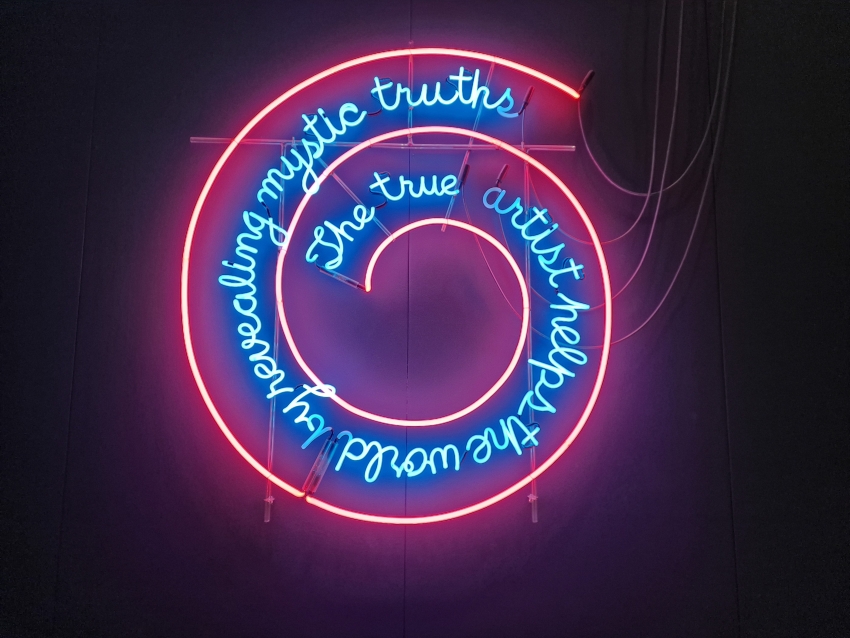 Bruce Nauman, The true artist helps the world by Revealing Mystic Truths (1967)
Photo by Luigi Paternoster / EcocNews
Bruce Nauman, The true artist helps the world by Revealing Mystic Truths (1967)
Photo by Luigi Paternoster / EcocNews
The European Commission has recently presented a proposal to reform the European Capital of Culture (ECoC) initiative to the European Parliament and the Council of Europe, considering that the current rules will come to an end in 2033.
We asked Dr. Valentina Montalto (Associate Professor of Regional Cultural Economics at KEDGE Business School–KEDGE Arts School) to give her views, as she was the lead author of the White Paper ‘40 Recommendations from 40 Years of ECoC’ co-written with Roberta Ferrarini, Camilla Donà delle Rose and Mojca Stubelj Ars[1], at the initiative of Chemnitz and in collaboration with Nova Gorica, both ECoC 2025.
In your opinion, what are the main points of the Commission’s proposal that were, in some way, suggested by the Chemnitz White Paper ?
First of all, let me start by thanking the over 60 ECoC managers and the research team for making this work possible, as well as the Commission to read carefully this piece of work. It is a real honour to see that the Chemnitz White Paper is contributing to European policy-making: a third of its recommendations have been - fully or partially - taken up in the Commission’s proposal.
Among these, I find at least three particularly significant.
Firstly, the general objectives of the initiative are better focused. Whilst remaining essentially the same, the new proposed formulation clarify the ultimate aim both of promoting European diversity (Objective 1) – that is, fostering a sense of belonging to the European project and its core democratic values – and of contributing to long-term development (Objective 2) – which must be geared towards inclusion and sustainability. This change has been inspired by Recommendation 1 of the White Paper.
The second – in line with Recommendation 2 – concerns the European dimension – the intended most distinguished attribute of the ECoC initiative but which, in reality, is still poorly understood and even less ‘put into practice’ during the implementation phase. This is an aspect that cannot simply be relegated to one of the selection criteria. An ECoC must be European at every stage of its planning. In line with the suggestions in the White Paper, the European dimension is thus transversally integrated across all the criteria, ensuring that the spirit of the European project permeates not only the cultural programme but also its governance and management model, its communication strategy and its ability to generate a lasting legacy in the cities.
Last but not least, the new rules introduce a brand new focus on working conditions of artists and cultural professionals – a change that closely echoes Recommendation 28 of the White Paper, which suggested introducing a ‘Code of Practice’ on this issue. In other words, candidate cities are asked to demonstrate how they intend to ensure adequate working conditions for the professionals involved, in line not only with the White Paper but also with one of the key pillars of the Culture Compass. While AgoraEU (i.e. the new umbrella programme that will house Creative Europe for the period 2028-2034, based on the Commission’s proposal) intends to reinforce social conditionality to access EU funding, the ECoC at the moment represents the most advanced EU cultural policy action featuring some form of social conditionality to win the title.
Which aspects of the proposal do you find most convincing, and which do you find least convincing?
There is one major issue – the elephant in the room – that still needs to be addressed: legacy. Let me be clear: long-term impacts remain at the heart of the initiative in various ways. They form an integral part of the initiative’s two overall objectives – which, as mentioned earlier, are now presented with a clearer statement of intent. Furthermore, one of the selection criteria is entirely dedicated to legacy. Finally, one of the proposed changes concerns the payment of the Melina Mercouri Prize, which would be split into two instalments precisely to ensure that part of the prize is paid at the end of the year with the aim of consolidating its legacy.
However, there are at least two areas that need to be strengthened to ensure a broader legacy. Firstly, measures could be introduced to ensure that benefits are maximised even for cities that do not win the title. In this sense, the White Paper (Recommendation 17) proposed including, amongst the selection criteria, the preparation of a ‘Plan B’ aimed at ensuring at least a partial implementation of what was outlined during the bid phase for those cities who do not ultimately get the title. Secondly, a harmonised and still flexible evaluation system needs to be established. This is a sensitive issue, particularly given the extremely heterogenous mix of winners involved. However, precisely in light of this difficulty, the evaluation cannot be left entirely to the winning city (i.e. the one required to produce a report within the year following the award), nor can we any longer accept as valid the list of indicators drawn up in 2014, which is now largely outdated, as it lacks clear metrics relating not only to the European dimension itself, but also to sustainability, artists’ working conditions and the digital sphere, where much of cultural creation and participation now takes place. The European Commission is currently setting up, as envisaged by the Culture Compass, a European Cultural Data Hub. This is the tool through which a revised set of metrics should be defined and the relevant data regularly collected and analysed.
The proposals will be subject to negotiations with Parliament and the Council. In light of the difficult situation Europe is currently facing, with wars on our doorstep and rising nationalism, are there aspects of the proposal that may undergo significant changes? To what extent do you think the current context will influence the final decision?
It will influence it greatly. The negotiations will not be straightforward. Not only because of political struggles but also – I fear – because of a lack of understanding of the initiative that needs to be addressed in greater depth.
The good news is that the rapporteur in Parliament – Hannes Heide – has followed Bad Ischl (ECoC 2024) very closely. Having someone who knows the initiative well is crucial for steering the ECoC towards a phase that clarifies and contextualises even more its objectives its impact, considering the delicate moment that Europe is going through.
As regards communication, it does not seem to me that any progress has been made, and everything continues to be left to the cities. Why is this issue once again in danger of being irrelevant?
It is by no means irrelevant, and the Commission is well aware of this. Rather, it is a question of understanding how to channel more resources into an initiative that has yielded increasingly professional and well-established results over time, whilst requiring only limited resources at European level (i.e. staff costs and €1.5 m Melina Mercouri Prize). Why allocate more resources to what we might perhaps describe as one of the most efficient European initiatives, with an extraordinary multiplier effect across the regions?
I found the answer in the words of Ursula von der Leyen in her latest State of the Union speech:
“Do we want a strong and independent Europe that defends its values in this world? Or do we want to let divisions and dependencies hold us back? Do we want to unite around the European idea that together we can determine our own destiny? Or do we want to allow proxies and puppets manipulated by authoritarian actors to undermine our democracies?
Whether we are talking about ultra-nationalists or anti-Europeans, or about interference or disinformation from Russia: the name may change, but the objective is the same. These actors scorn Europe’s values and seek to tear European unity apart. So let us not merely fight against these threats: let us fight together for our vision of Europe.”
Today, much more than the future of a title is at stake. The very future of Europe is at stake. And this is played out first and foremost at local level.
From your perspective, how do you see the future of the ECoC programme?
The European Capital of Culture initiative: it is either European or it isn’t. In other words, its ultimate aim can and must be Europe. The question at the heart of a city’s bid should not only be: what can Europe offer me? But also: how can my city contribute to a more culturally and socially cohesive Europe?
It is not easy to make predictions in such an uncertain context. What I can say is that the Commission’s proposal is, courageously, heading in the right direction. And this is already an achievement that we could not have taken for granted. It is now up to all of us, each in our own small way, to try to mobilise our representatives in Parliament so that what has been proposed not only remains in place but is also further strengthened.
[1] Supervised by Chemnitz’s strategic advisor Mattijs Maussen and with project coordination ensured by Anely Smida Jeromin.

Ecocnews Founder, Journalist, repentant jazz guitarist, music critic and film lover.
Online newspaper based in Matera
EcocNews is registered at the Court of Matera in the press register n. 2/2021
Editor in chief: Mariateresa Cascino. Founder and editorial director: Serafino Paternoster
via San Francesco, 1 - 75100 Matera (Italy)