



Online newspaper based in Matera
EcocNews is registered at the Court of Matera in the press register n. 2/2021
Editor in chief: Mariateresa Cascino. Founder and editorial director: Serafino Paternoster
via San Francesco, 1 - 75100 Matera (Italy)



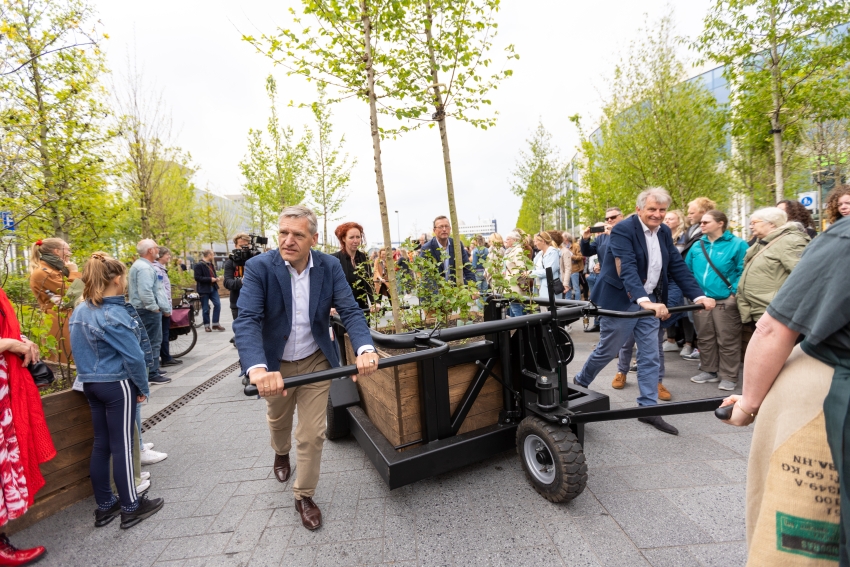 Bosk, Leeuwarden
Photo by Lucas Kemper
Bosk, Leeuwarden
Photo by Lucas Kemper
What remains of a Capital of Culture once the spotlight fades? That is the question running through the *study by Madoka Sugawara, Tomoyuki Mashiko and Susumu Kawahara on Leeuwarden-Friesland, the Dutch city that held the title of European Capital of Culture in 2018.
Their conclusions offer an unusual but useful starting point: the formation of a cultural legacy is not an outcome that materialises once an event is over, but a process that begins much earlier, already in the bidding phase, and can continue for years through long-term programming. The case of Leeuwarden shows that real change is possible when cultural programming grows out of early civic planning, is aligned with regional development goals, and responds to concrete social needs. Residents, the authors stress, are not mere beneficiaries but active stakeholders in shaping outcomes.
From this premise follows the study's second finding: a structural distinction between intentionally designed cultural legacies and emergent social legacies. The former arise from planned choices — the creation of new organisations, support systems for amateur cultural associations, methodological tools designed to be replicated. The latter emerge more indirectly, almost as a by-product of sustained engagement: a strengthened sense of community, a shift in individual awareness, civic pride consolidated through participation in a shared project. Yet the two levels are not separate: cultural, social and economic impacts are interwoven in a circular mechanism, in which cultural outcomes generate social and economic benefits that, in turn, justify further investment and sustain the political support needed to carry the process forward.
The third point concerns the often underestimated role of the legacy organisation. In Leeuwarden, the trust built during the title year — think of the episode recounted by Immie Jonkman, CEO of the legacy organisation (later head of Arcadia), when a stranger grasped her hand and told her "I'm so proud of Leeuwarden that we did this" — did not dissolve once 2018 ended, but fuelled a new phase of activity. This is how Arcadia was born: a ten-year programme with triennial editions (2022, 2025, 2028) that inherited the networks, skills and knowledge built up during the Capital of Culture year. The legacy organisation thus proves to be the crucial element capable of turning temporary cultural momentum into a lasting structure, able to survive the natural fading of media and institutional attention that accompanies the title.
Finally, the authors highlight how the choice to focus on projects with strong local significance, alongside some economically significant initiatives, allowed culture to be positioned as a political resource, lowering the barriers to sustaining the legacy. Equally important was the strategic diversification of content: each project was designed to address one or more thematic priorities — economy, inclusion, art, sustainability — while maintaining overall coherence. Citizen participation, for its part, was organised across three distinct levels, from grassroots initiatives to large-scale international artistic productions. This balance between locally rooted projects and high-visibility flagship events allowed Leeuwarden to combine inclusiveness with artistic quality, responding to regional social challenges while attracting institutional support at the same time.
To reach these conclusions, the researchers had to tackle a problem typical of this kind of study: how to reconstruct a process that began more than a decade earlier, once the temporary organisations linked to the event had long since dissolved and the people involved had scattered. The solution was the construction of a hypothetical chronological diagram of legacy formation, used as an elicitation tool during interviews: shown to participants, it allowed them to reconstruct the sequence of events more precisely, distinguishing what had been planned from what had emerged spontaneously. This was complemented by an analysis of final reports, official websites, bid-books and printed materials, together with a questionnaire addressed to members of the legacy organisation.
Concretely, Leeuwarden's story begins with a group of thirty young people connected to the region, concerned about youth outmigration from Friesland, who chose as the theme of the bid "Mienskip", a Frisian concept of community solidarity rooted in local culture, later broadened into "Iepen Mienskip" — open community — to avoid the impression of an inward-looking idea. As early as 2013, four years ahead of the title year, the city and the province drew up a regional agenda envisaging a total investment of €852 million through to 2025, designed to continue regardless of the outcome of the bid: a clear signal of the intention to treat culture as a lever for structural development rather than a one-off episode. After the title year, the region committed 10% of its cultural budget — more than €19 million a year for five years — to supporting legacy activities.
Perhaps the most striking finding concerns the scale of public participation: around 62,000 people were involved, equivalent to 10% of the region's population, with 68% of residents reporting they felt part of the project and 78% of events fostering cooperation across generations. These figures stem from a three-tier structure that reconciled artistic ambition with broad-based participation: at the top, large international productions such as "The Giants of Royal de Luxe", generating visibility and economic spin-offs; at an intermediate level, collaborative projects between artists and residents; and at the base, a fully bottom-up programme that on its own accounted for roughly 90% of all projects, amounting to up to 800 initiatives spontaneously launched in villages and neighbourhoods across the region.
When the title year drew to a close, an internal review found that some long-term goals had not been fully achieved, prompting the organisation to rethink its strategy for the following phase. This gave rise to Arcadia, which adopted a more selective approach than LF2018's fully open model, concentrating resources on projects of higher artistic quality and retaining only the intermediate layer of collaboration between artists and communities. An emblematic example of this transition is "BOSK", a 2022 project that moved hundreds of trees in wheeled planters through the city for a hundred days, relying entirely on local volunteer effort, without drawing on the international artistic resources that, in the case of "Giant", had led to an outflow of funds abroad. BOSK went on to win the Dutch Design Award 2023 and remained etched in the city's collective memory, spontaneously recalled by residents well after the fact, regardless of whether they had been directly involved in 2018.
Not everything, however, could be documented with the same precision. The most significant limitation identified by the authors concerns precisely the base layer of the original programme: because its fully open nature involved no structured collection of participant data, it is now impossible to establish how many of the 700–800 spontaneous initiatives actually survived, where their promoters are today, or what content they retained over time. It is a gap that weighs on the most genuinely grassroots part of the whole operation, the one that best embodied the spirit of "Mienskip", and one the authors flag as a priority for future research.
From this combination of findings and limitations comes the study's most concrete message, addressed explicitly to cities preparing to enter the competition for the title of European Capital of Culture. The first recommendation is not to treat legacy as an afterthought, but to build it into the process from the bidding phase onward, identifying regional challenges from the outset and shaping a theme capable of speaking to local identity, as happened with "Mienskip". The second is to design a multi-tier participation structure, able to hold together high-impact flagship events with widespread initiatives genuinely run by citizens, avoiding both excessive concentration of decision-making power and fragmentation into countless low-quality efforts. The third recommendation concerns setting up, from the very start, a legacy organisation with a mandate extending well beyond the title year, capable of turning temporary enthusiasm into lasting structures, networks and skills.
Finally, the authors insist on a methodological point that is also a policy lesson: without robust monitoring systems capable of collecting data from the preparation phase onward — through shared platforms, public project archives, periodic community surveys — intangible legacies risk remaining invisible, even when they are real. Investing in documentation, the researchers conclude, is not a bureaucratic add-on but an essential part of the strategy itself: only in this way can the cities now stepping into the competition not only build an authentic legacy, but also demonstrate it, learn from it, and pass it on to those who come after.
*The study by M. Sugawara, T. Mashiko and S. Kawahara, "Exploring Event Legacies in the European Capital of Culture: A Case Study of Leeuwarden-Friesland 2018", Event Management, 2026. Download here.

Ecocnews Founder, Journalist, repentant jazz guitarist, music critic and film lover.
Online newspaper based in Matera
EcocNews is registered at the Court of Matera in the press register n. 2/2021
Editor in chief: Mariateresa Cascino. Founder and editorial director: Serafino Paternoster
via San Francesco, 1 - 75100 Matera (Italy)